
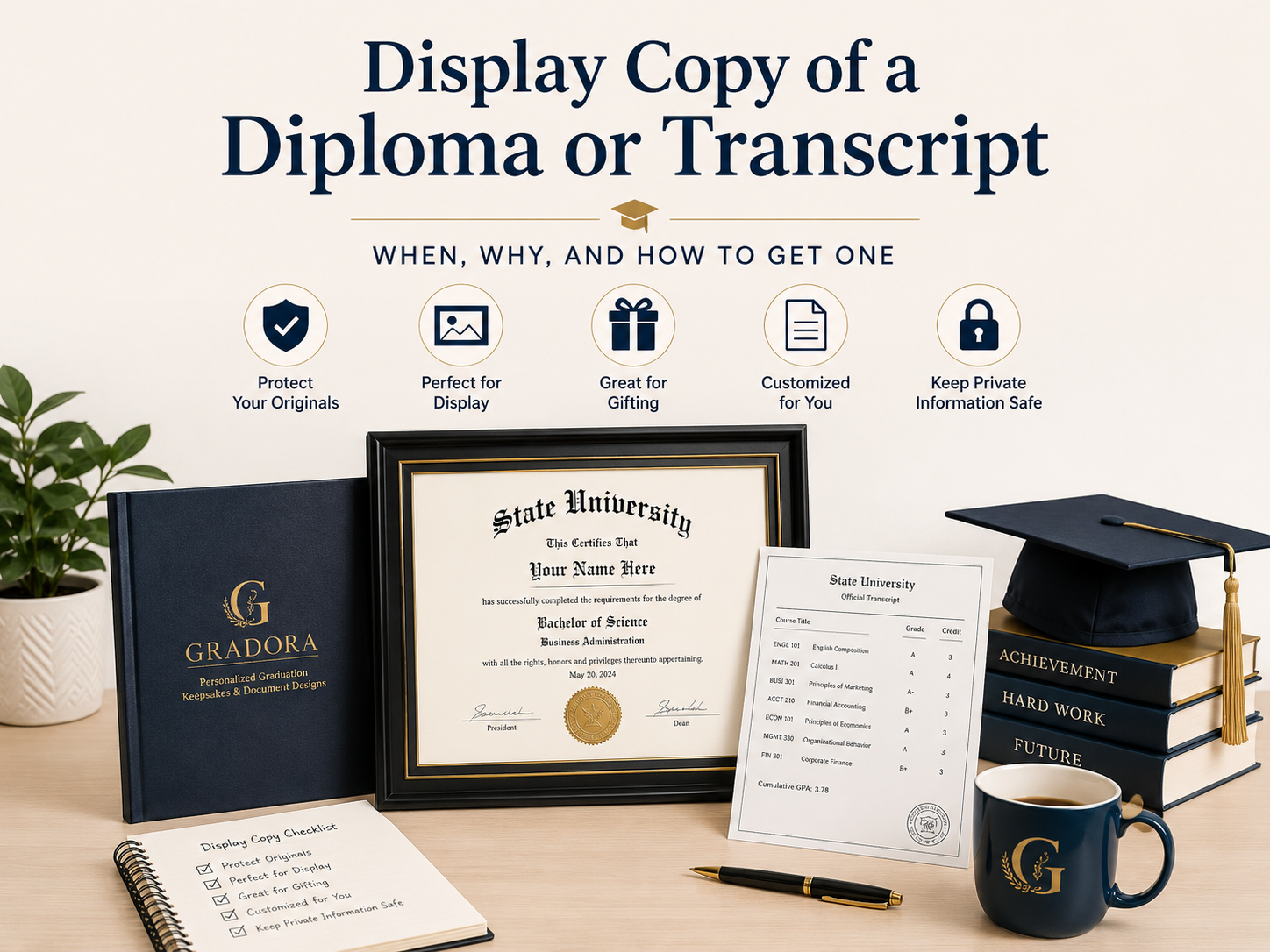
Original diplomas and transcripts are surprisingly hard to live with. They arrive in one fragile copy, they fade in sunlight, and most people are too nervous to frame the only version they own. So when you want something on the wall — or a clean copy for a home office, a memory wall, or a personal archive — the real answer is usually a separate display copy, not the original.
This guide walks through what a display copy actually is, when it makes sense, how to decide on format and materials, and what details you need to prepare before ordering one. It also covers the part most pages skip: how to use a display copy responsibly.
Table of Contents
ToggleWhat “Display Copy” Actually Means
A display copy is a custom-designed version of a diploma, certificate, or transcript created specifically for showing, gifting, or keeping — not for official use. It is not a reprint issued by your school, and it is not a certified duplicate. It is a presentation piece.
That distinction matters more than it sounds. An official replacement comes from the institution, carries their seals and registrar signatures, and is the document you would hand to an employer or licensing board. A display copy is something you commission for the wall or the shelf. The two serve completely different purposes, and trying to use one as the other is where people get into trouble (more on that at the end).
If what you actually need is a legally valid replacement of a lost diploma, your first stop should be your school’s registrar — not a design service. Display copies exist for everything after that: the version you’re comfortable hanging, gifting, or handling every day.
When a Display Copy Is the Right Choice
A few situations come up again and again:
- You don’t want to risk the original. Framing the only copy you own means light, humidity, and handling slowly damage an irreplaceable document. A display copy lets the original stay flat, dark, and protected.
- You want more than one on the wall. Originals come as a single copy. If you want one at home and one in a parent’s house, or one in the office and one in storage, a display copy is the only practical way.
- You’re giving it as a gift. A graduation, a milestone degree, or a long-overdue celebration of someone’s achievement is a common reason people commission a personalized version.
- You need a clean piece for a project, set, or themed space. Photographers, event planners, and people building a “wall of accomplishments” often want a presentable piece that isn’t the fragile original.
If none of these apply and you simply need the document for an official purpose, a display copy isn’t what you’re looking for.
Step 1: Decide the Purpose First
Before anything else, get clear on what the piece is for, because that single decision drives every other choice — layout, paper, size, and finish.
Ask yourself: Will it be framed and hung? Stored flat as a keepsake? Used as a prop or in a photo? Added to a personal collection? A piece meant for a large frame on a wall has different requirements than something tucked into a memory box. Nail this down first and the rest of the decisions get much easier.
Step 2: Choose the Right Design Style
There are three common styles, and they suit different goals:
- Diploma-style designs are the classic framed look — clean, formal, and built for wall display. This is what most people picture and what works best above a desk or in an entryway. For a deeper look at what a keepsake piece involves, see our guide on what a diploma keepsake is.
- Transcript-style designs lean toward detail and records. They suit personal archives, document-style presentation, or themed projects where the listed coursework is part of the appeal.
- Certificate-style designs work well for awards, events, recognitions, and more decorative or creative uses.
In our own orders, the clear favorite is a degree-style design with raised gold or silver foil lettering (foil embossing). The metallic, slightly raised text is what makes a piece feel ceremonial rather than printed, and it photographs beautifully on a wall. Most of these are bought for one of two reasons: to frame and hang as a celebration of an achievement, or to give as a gift to a friend or family member. A small number of customers also order them as props or as a lighthearted gift to tease a friend — perfectly fine, as long as it stays in the for-fun, personal-use lane.
Step 3: Think About Materials and Size
This is where a display copy earns its keep, and where it’s worth being specific.
Paper. Heavier, textured stock reads as “real” far more than thin printer paper. At THEGRADORA, our standard pieces are printed on 150 gsm card stock (woodfree paper) in your choice of ivory or cream, which gives the piece a substantial, document-like feel. For a more premium look, we also offer a parchment-style stock that mimics the weight and texture people associate with traditional diplomas.
Size. Standard frame-friendly sizes make life easier later. Our most popular in-stock sizes are 8.5×11 in, 11×14 in, and A4 — all easy to match with off-the-shelf frames. If you need something larger for a statement wall piece, we can also produce custom sizes such as A3.
Finish and framing. Decide up front how you want it presented. We offer four options: a digital file only, a printed piece (unframed), a printed piece in a leather diploma cover, and a printed-and-framed piece. Framing is an add-on, and because frame cost depends on the size of the certificate, the price varies by the size you choose.
Matching the size to a standard frame from the start saves you the frustration of hunting for an odd-size frame later — and if you’d rather not deal with framing at all, the leather cover is a popular, gift-ready alternative.
Step 4: Prepare Your Details Carefully
Whatever style you choose, gather the exact wording you want before you order. This usually includes the name, title or degree, date, location, an institution-style name, program wording, and any other display text.
The single most important thing here: proofread everything before submitting, especially if the piece will be printed. A typo in a framed piece means reprinting and reframing. Check spelling of names, the exact degree wording, and the date format. It helps to have a second person read it over — we see avoidable mistakes most often in names and dates.
In our experience, the two mistakes that come up most are misspelled names and dates entered in the wrong format (for example, swapping the day and month). Both are easy to miss when you’re typing quickly and both are expensive to fix once a piece is printed and framed. Double-check the name character by character, and confirm whether your date should read month-day-year or day-month-year before you submit. Learn how to personalize a custom diploma.
Step 5: Choose a Provider That Communicates Clearly
The difference between a piece that looks polished and one that looks cheap usually comes down to execution: good formatting, balanced spacing, clean typography, and careful packaging so it arrives undamaged. Look for a provider who confirms details with you before printing rather than one who just runs the file as-is.
For reference, a typical THEGRADORA order takes about 7–10 days from order to delivery — usually 2–3 days to produce the piece and 4–6 days for shipping. We ship internationally by air via FedEx and DHL. Digital-only files, of course, are ready much sooner since there’s no production or shipping involved.
Important: Use a Display Copy Responsibly
This part isn’t fine print — it’s the most important section on the page.
Custom diploma and transcript-style designs are not official documents. They are not issued by schools, universities, accredited institutions, or government agencies. They must never be used for employment, academic admission, official records, identification, licensing, or credential verification. Using a display copy to misrepresent academic credentials is fraud, and it’s not what these pieces are for.
A display copy is for novelty, display, keepsake, and personal use. Used that way, it’s a meaningful and completely legitimate way to celebrate an achievement.
At THEGRADORA, every custom document-style design is created for exactly that purpose — to help you create a clean, personalized presentation piece while keeping use clear and responsible.
Looking to create one? Browse our custom diploma and certificate designs.
New to keepsakes? See our complete guide to custom diploma and certificate keepsakes.