Last updated: 2026 · Written with input from families who've navigated this process
When someone you love passes away, their diploma often ends up meaning more than it ever did while they were alive. Not because the paper suddenly becomes more valuable — but because it becomes one of the few tangible things left that says: this person achieved something, and here is the proof.
For many families, that piece of paper is missing. Sometimes it was lost decades ago. Sometimes it got damaged in a flood, a house move, or a nursing home transition. Sometimes the school closed and the records went with it. Sometimes it was thrown out during an estate cleanup by someone who didn't realize what it was. And now, when you'd give almost anything to hang it on the wall, it's gone.
This guide is for anyone who's in that place — trying to honor a parent, grandparent, sibling, or spouse whose original diploma can't be recovered. It covers what a memorial diploma keepsake actually is, when it makes sense, how families typically approach the design decisions, and what it can and can't be. Nothing in this guide is a substitute for official records if those records can still be retrieved. But when they can't, or when the diploma had emotional significance far beyond its legal value, a keepsake replica can restore something that was lost.
Table of Contents
ToggleThe Short Answer
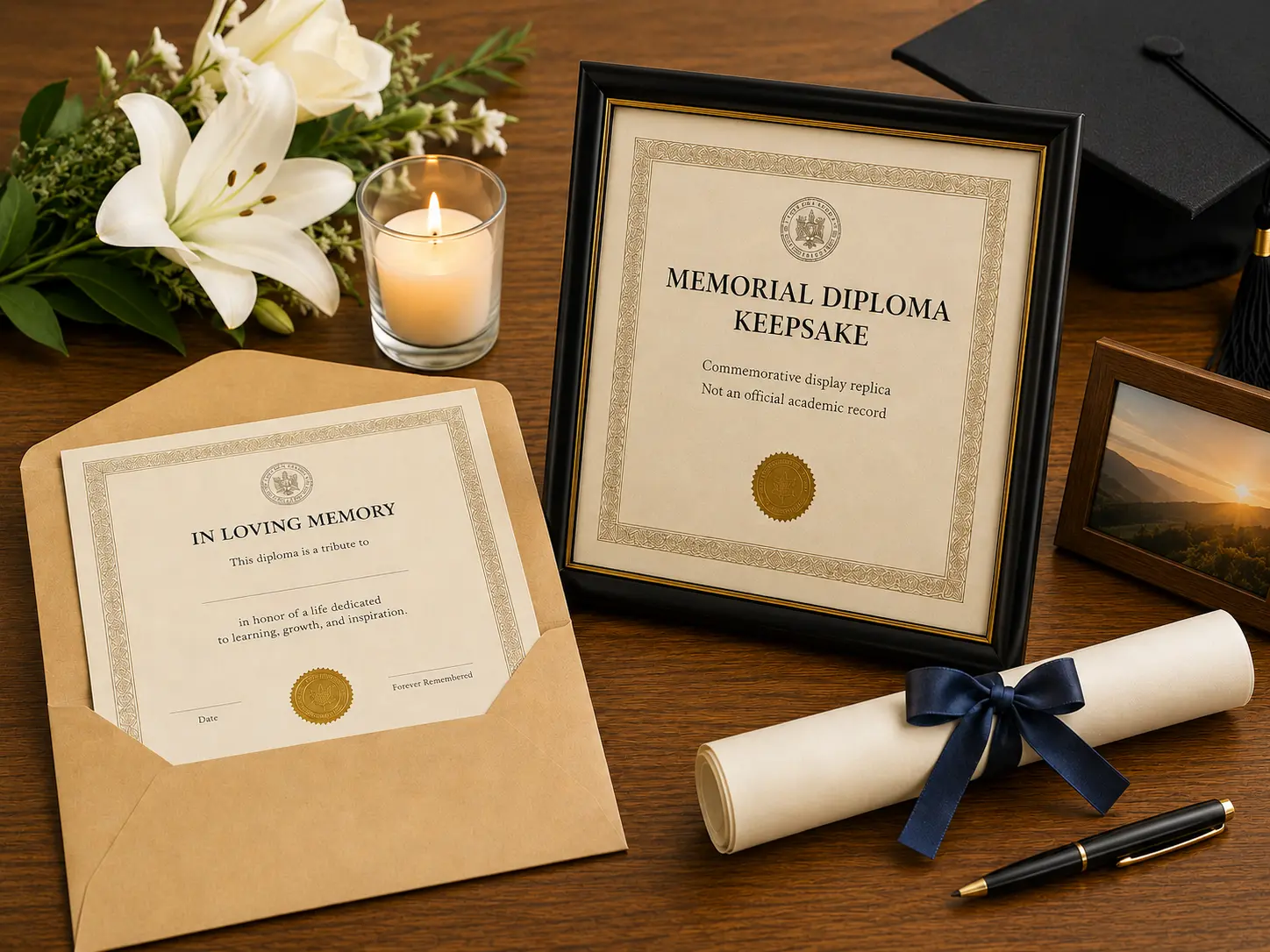
A memorial diploma keepsake is a commemorative reproduction of a deceased family member's high school or college diploma, created for display, memorial, or family heritage purposes. It's clearly labeled as a keepsake replica — not an official document — and it exists to fill a specific need: honoring someone's achievement when the original is gone and can't be recovered.
Families typically order memorial keepsakes when:
- The deceased's original diploma was lost, damaged, or destroyed before or after their passing
- The school has closed and records aren't recoverable
- The family wants a multi-generational diploma display and older family members' originals don't exist
- The original exists but is too fragile to display safely
They serve a genuine emotional purpose — one that research on grief and remembrance backs up.
Why Memorial Displays Matter More Than People Think
The impulse to create a physical memorial isn't just sentimental. It's psychologically significant, and it's been studied.
Grief researchers use the term continuing bonds to describe the healthy, ongoing connection bereaved people maintain with those they've lost. This isn't the same as "not moving on" or "being stuck in grief" — it's the opposite. A large body of psychology research over the last thirty years has established that maintaining tangible, ritualized connections to a deceased loved one supports emotional adjustment rather than delaying it. Studies published in journals like PLoS One have documented how memorial practices that support meaning-making, recognition, and emotional expression can buffer the distress of grief and contribute to important psychological benefits.
Physical objects — photographs, jewelry, framed keepsakes, framed achievements — are how humans have marked continuing bonds for as long as we've had walls and mantels. Funeral homes across the U.S. have expanded their keepsake offerings over the last decade for exactly this reason. The industry has recognized that a small, tangible object families can see and touch every day helps grief resolve in a way that memorials only visited occasionally cannot.
A framed diploma occupies a specific psychological niche within this. It says something different from a photograph. A photograph captures how someone looked. A diploma commemorates what they did — their effort, their achievement, the milestone they crossed. For many families, especially those honoring immigrants, first-generation graduates, or family members whose education came at real cost, that meaning is significant beyond words.
When the original diploma is gone, that meaning has nowhere to sit. A keepsake replica gives it a place.
When the Original Is Lost, Damaged, or Never Recovered
Before deciding on a keepsake, it's worth confirming whether the original really is unrecoverable. Many families assume records are lost when they're actually still available. The path depends on when the deceased graduated:
If the school is still open
Contact the school district that currently administers the school. As the deceased's legal heir, you can typically request records of the departed with a death certificate, proof of your relationship (birth certificate, marriage certificate), and proof of your legal authority (executor letter, court order, or in some states a sworn affidavit). See our lost high school diploma guide for the general process.
If the school has closed
Closed school records don't disappear — they're transferred to the absorbing district, county Regional Office of Education, or state Department of Education. See our closed school records guide for the full process.
If records truly can't be recovered
This happens rarely but does happen — most commonly for very small private schools, religious schools that closed without transferring records to a diocese, or schools whose records were lost to fire, flood, or improper disposal. In these cases, official replacement isn't possible.
This is when a memorial keepsake replica becomes the meaningful option. It won't fill the same legal purpose as an official record — a keepsake is a display piece, never a verification document — but for the emotional need to honor and remember, it does the work an official replacement would have done had one been available.
What Makes a Meaningful Memorial Keepsake
Families that have gone through this process tell us the same few things matter more than they expected. Design details that feel small at the ordering stage turn out to carry weight later.
Get the name exactly right
This sounds obvious, but naming decisions are surprisingly emotional. Should it read "Elizabeth Anne Marshall" (their full legal name at graduation) or "Betty Marshall" (what everyone called them)? Should it include their maiden name if they married later? What about honorifics or professional titles they earned decades after graduation?
For memorial keepsakes, most families choose the name the deceased actually used at graduation — not the name they became known by later. It preserves the historical accuracy of the moment being commemorated. But this is entirely a family decision, and some families prefer the familiar version. There's no wrong answer as long as it feels right to the people who will see it every day.
Choose the correct graduation year
Older family members sometimes don't have precise records of when they graduated. A family member might have said "the class of 1952" for decades, but the actual year turns out to be 1951. If precision matters to you, cross-reference against Social Security, marriage certificates, or family records before ordering. If the exact year isn't verifiable, an approximate year is fine — this is a memorial piece, not a legal record.
Decide on the school name and identifying details
Include the actual high school (or college) name if you know it. If the school has been renamed since the deceased attended, use the original name. This is a memorial to a specific historical moment, not a current representation of the school. If the school no longer exists at all, that's still fine — the name goes on the keepsake exactly as it appeared at the time.
Consider the design era
Most reputable keepsake providers offer designs approximating the style of diplomas from different decades — the ornate calligraphy and heavy borders common in the 1930s–1950s, the cleaner mid-century designs of the 1960s–1970s, the simpler modern layouts from the 1980s onward. If you have any photograph or memory of the deceased's original, matching the era approximately makes the memorial feel more authentic. If you have no reference, choose a design that suits the era they graduated in.
Signatures are a family choice
Official replacement diplomas use the current principal and superintendent signatures, which for memorial keepsakes often defeats the point. Reputable keepsake providers will let you specify whether to include period-appropriate signature blocks (with or without actual names) or leave the signature area blank. For memorial pieces, many families prefer either a generic period signature line or the deceased's own signature if available from another document — it makes the piece more personal.
Where to Display Memorial Keepsakes
Families do this in a lot of different ways. A few of the most meaningful arrangements:
Solo wall display. A single framed memorial keepsake on a study wall, home office, or bedroom. This works especially well when the deceased's diploma was significant on its own — a first-generation college graduate, an immigrant who graduated after coming to the U.S., an achievement that took extraordinary effort.
Multi-generational family wall. Several framed diplomas from grandparents, parents, and adult children displayed together. When older generations' originals don't exist, keepsake replicas fill the gaps so the display feels complete rather than partial. This is one of the most requested memorial keepsake uses.
Shadow box or memorial cabinet. A framed keepsake alongside other memorial objects — photographs, medals, letters, jewelry — arranged in a shadow box or memorial cabinet. This works well when the diploma is one piece of a broader remembrance rather than the sole focus.
Anniversary or milestone display. Some families bring the keepsake out for specific occasions — the anniversary of graduation, a family reunion, a memorial gathering — and store it carefully the rest of the year. This works for families where daily display isn't practical.
Gift to another family member. When one branch of the family holds the original documents and other branches don't, keepsake replicas let each household have its own display. This is especially meaningful for adult grandchildren who never met the deceased in person.
Real Family Scenarios
The situations that lead families to memorial keepsakes are usually specific. A few we see repeatedly:
The grandparent's diploma that got thrown out during estate cleanup
This is one of the most common situations, and it usually comes with guilt attached. Someone was going through the deceased's papers under time pressure, didn't recognize what they were looking at, and threw out something irreplaceable. The realization comes weeks or months later. Since the original school records might no longer exist (especially for pre-1970 graduates), an official replacement often isn't possible. A keepsake replica lets the family restore what was lost without pretending it's the original.
The immigrant grandparent whose home country records are unrecoverable
Families with grandparents who graduated in another country before immigrating often face impossible records searches. Political instability, wars, changed borders, and simple record loss make retrieval difficult. When the deceased's achievement matters to family history — especially for first-generation American families — a memorial keepsake in an approximation of the original country's diploma style can preserve that history in a way records searches can't.
The parent whose diploma was destroyed in a house fire before they passed
When a diploma is lost during someone's lifetime and then the person passes before ordering a replacement, families are often left with the sense that the milestone was never properly honored. A keepsake replica ordered after passing, especially if the parent had talked about wanting to replace the original, becomes an act of completing something they didn't get to.
The multi-generational family that wants a display for everyone
Families with strong educational traditions sometimes create walls or hallways displaying every graduate — sometimes across four or five generations. Older diplomas often don't exist anymore. Rather than leaving the older generations off the wall, families order keepsake replicas designed to match the period of each graduate's actual education. The result is a display that spans a hundred years of family achievement.
The sibling who wants to honor a parent the surviving family didn't
Sometimes only one family member wants to honor a deceased parent's education. If the family original went to a different sibling and can't be shared, a keepsake replica lets that family member create their own memorial without depending on the family original.
Working With Family During Grief
A few practical notes if you're the person driving this decision on behalf of a family in mourning:
Give the decision time. Ordering a memorial keepsake within the first weeks after loss is rarely urgent. If you're in acute grief, give yourself a month or two before making decisions that will live on a wall. The keepsake will still be there when you're ready. Rushing tends to produce regrets — the wrong name spelling, the wrong graduation year, the wrong design era.
Involve the people who will see it. If the keepsake will be displayed in a shared family space, make sure the people who see it every day feel good about the design choices. Small design elements — a signature, a border style, an era — feel different to different family members.
Verify the details you can verify. Names, dates, and school details are hard to fix after the keepsake is made. If Grandma's first name was actually Margaret but everyone called her Peggy, decide which name goes on the keepsake before ordering, not after.
It's okay if this is the wrong thing right now. Some families order memorial keepsakes six weeks after loss. Others order them six years later, or on the twenty-year anniversary of a passing. There's no schedule. If it feels wrong right now, wait. If it feels right, that's when to do it.
What a Memorial Keepsake Is Not
Even in memorial contexts, the compliance line stays where it is. A keepsake replica of a deceased family member's diploma is:
- A commemorative display item — the same category as a framed art print, a family portrait reproduction, or a memorial photograph
- A personal record — kept by the family, not submitted to any institution
- A memorial and heritage piece — meant to honor the deceased's achievement, not to represent it as an active credential
A memorial keepsake is not:
- A legal document establishing that the deceased graduated
- A substitute for records needed in estate, probate, or benefits proceedings
- Something to submit in place of official records to a school, employer, or government agency
- A verification tool for background checks, benefits eligibility, or similar purposes
For any purpose that requires legal verification of the deceased's education — for example, some estate or Social Security processes that require confirmation of educational credentials — you'll need official records from the school district or, if records aren't available, a "no records found" letter from the district or state archive. A keepsake replica cannot serve that function.
This distinction matters both legally and, honestly, ethically. The whole point of a memorial keepsake is to preserve real memory of a real achievement. Using it as anything other than what it is — a display piece — undermines both the memory and the achievement.
Timeline and Cost Considerations
Memorial keepsakes have simpler logistics than official replacements. There's no district verification queue, no records office to navigate, no summer break to work around. Typical timelines:
- Design confirmation: 1–3 business days after ordering, when a proof is sent for you to review
- Production: 5–10 business days for hand-crafted pieces
- Shipping: 3–7 business days for domestic delivery
- Total time: typically 2–4 weeks from order to arrival
Costs vary by the level of customization and the physical medium (paper stock, embossing, framing options). Memorial keepsakes tend to run higher than pure decorative replicas because the personalization is more involved — matching a specific era, incorporating specific signatures, coordinating with family details.
If you have an important anniversary or gathering approaching, order at least 4–6 weeks in advance to allow for design revisions and unexpected shipping delays. Reputable providers won't rush a memorial piece to meet an unrealistic deadline — this is one area where getting it right matters more than getting it fast.
Browse our diploma keepsake display options to see design styles that approximate different eras and school types.
FAQ
Is a memorial keepsake different from a regular replica diploma?
Only in intent and personalization. The physical product is the same class of commemorative replica. Memorial keepsakes are usually more personalized — specific era design, specific name and date accuracy, sometimes specific signatures — because they're honoring a specific person's memory.
Can I order a memorial keepsake if I'm not the closest surviving relative?
Yes. Anyone can order a memorial keepsake for personal display. Keepsakes are decorative products, not legal documents, and no proof of relationship is required.
What if I don't know the exact graduation year?
Order with your best estimate. Family memory, other records (obituaries, marriage licenses, Social Security records), or school yearbooks can often confirm the year. If precision truly isn't possible, an approximate decade is acceptable for a memorial piece.
Should the memorial keepsake use the deceased's married name or maiden name?
The name they graduated under. This preserves the historical accuracy of the moment being commemorated. If you prefer the name they were known by later, that's a family choice — both are legitimate.
Can I include the deceased's actual signature on the keepsake?
Some providers accommodate this if you supply a scan or clear photograph of a signature from another document. It's a meaningful personalization when the deceased's handwriting is significant to the family.
What if the school has been closed for 70 years and no one remembers exactly what the diploma looked like?
Providers offer period-appropriate design templates based on the general style of diplomas from that era. If you have even one photograph of a diploma from a similar time and place — a family member, a friend of the family, an internet image — it can help match the style approximately. Exact matching isn't possible when no original reference exists.
Can I get a memorial keepsake for a college diploma, not just high school?
Yes. Memorial keepsakes work for high school, college, professional certifications, or any academic credential the deceased earned. The process is the same — provide the details you know, choose a design era, and confirm the design proof before production.
How do I honor a family member whose records are recoverable but I want a display anyway?
Order both. Request the official replacement from the school district (or successor institution) for your family records — you'll have documentation if anyone ever needs it. Order a keepsake replica for the wall display. Store the official replacement in a fireproof, waterproof safe.
Are memorial keepsakes appropriate as gifts to other family members?
Very much so. Adult grandchildren, siblings, spouses, and other close family members often deeply appreciate a personalized memorial piece. Many families order multiple keepsakes at once so each household can have one.
How do I explain a memorial keepsake to family members who might not understand?
It's the same category as a framed family portrait, a memorial photograph, or a shadow box of medals — a physical tribute meant to preserve memory. If a family member objects on the grounds that "it's not the real diploma," you can be honest with them: it's not the real diploma, and it isn't pretending to be. It's a memorial piece that fills the space the real diploma would have filled if it still existed.
What should I do if I feel guilty ordering something that isn't the original?
This is common. Many families feel that ordering a replacement or replica of something the deceased owned is somehow disloyal to their memory. Consider it this way: the memory being preserved is their achievement. The paper was just the certificate. Honoring the achievement with a physical tribute is not disloyal to their memory — it's exactly the opposite.
Can I order a memorial keepsake before someone has passed?
Yes. Some families order keepsake replicas for elderly relatives before passing — either as a gift they can enjoy, or to preserve historical accuracy while the person can still confirm details like exact name spelling, graduation year, and school name. This is often the best approach if a loved one is in their final years and family records are uncertain.
This guide draws on established research on grief and continuing bonds, funeral industry practices, and common family scenarios. If you're navigating recent loss, please also consider connecting with a grief counselor or support group — physical memorials support grief resolution, but they work best alongside emotional support, not instead of it.