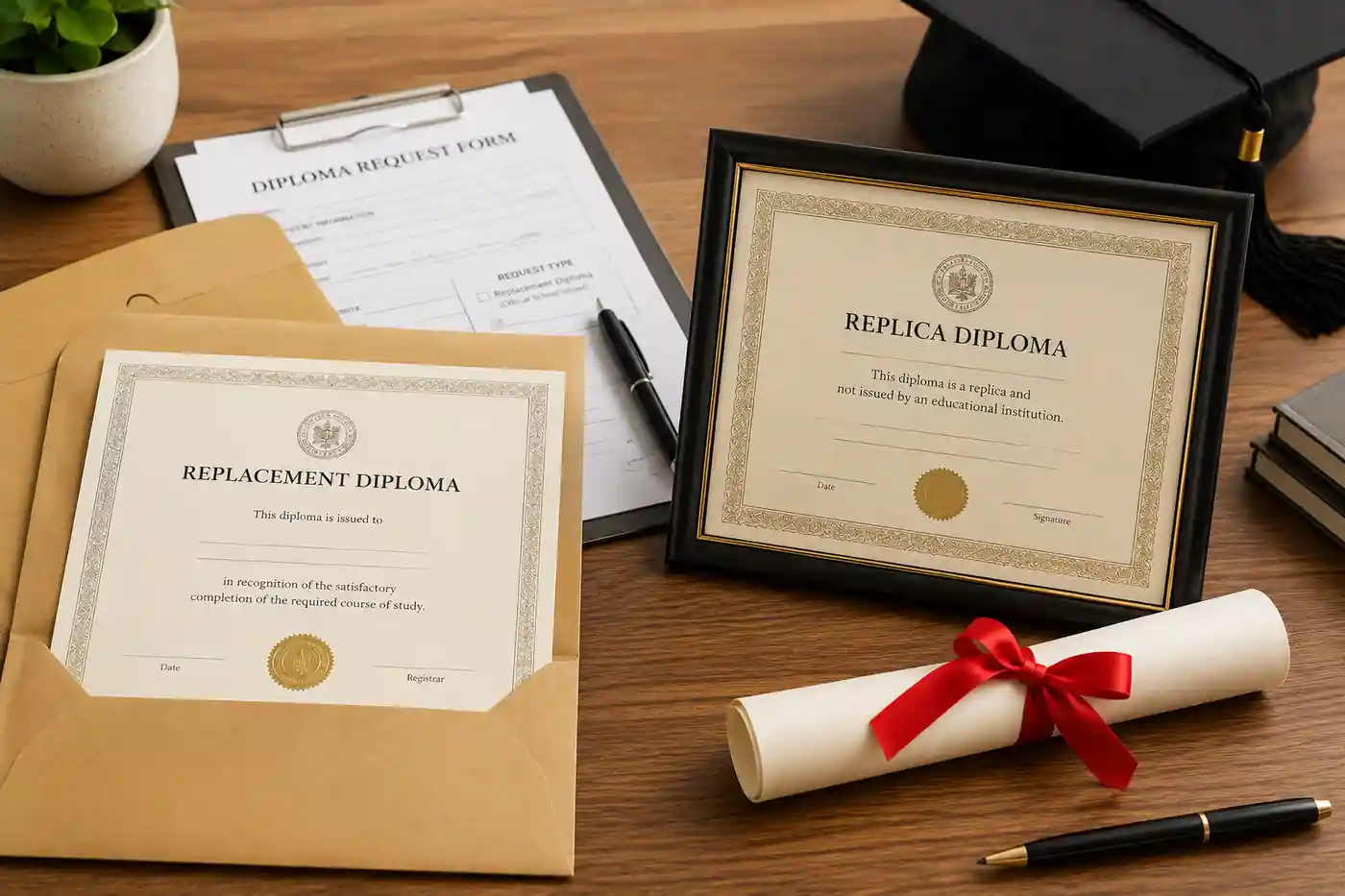
Last updated: 2026 · Independently researched, verified against FTC guidance and current school district procedures
If you've been searching for a diploma copy online, you've probably run into three very different products all using overlapping language: "replacement diploma," "replica diploma," "duplicate diploma," "novelty diploma," "keepsake diploma," "custom diploma," and — the one you should never buy — "fake diploma." They sound similar. They are not the same thing.
Choosing the wrong one at best wastes your money. At worst, it lands you in FTC territory. In 2014, the Federal Trade Commission shut down a single operation — Diversified Educational Resources — that had made $11 million selling fake high school diplomas to consumers who thought they were real. Buyers used them to apply for jobs, colleges, and military enlistment. Many were charged. Many were fired. None of them got their money back.
This guide draws a clear line between the three product categories so you know exactly what you're buying, when to buy it, and — importantly — when not to. If you're looking for the official document to prove you graduated, that's a replacement diploma and the path is straightforward. If you're looking for something to display, gift, or commemorate, that's a replica or keepsake diploma. Anything sold as an "official-looking" document meant to be used for verification is neither — it's a fake, and it's illegal to use.
Table of Contents
ToggleThe Short Answer
Three products. Three uses. Don't mix them up.
- Replacement diploma — issued by your school district, legally certifies your graduation. Use for anything official.
- Replica or keepsake diploma — decorative reproduction for display, gifts, or memorial purposes. Never used for verification.
- Fake diploma / diploma mill product — sold to misrepresent education you don't have. Illegal to use for jobs, school, or licensing. Avoid entirely.
Almost everyone searching "diploma replacement" needs option 1. Most people also want option 2 for their wall (or a family member's). Nobody needs option 3.
What Is a Replacement Diploma?
A replacement diploma is an official reissue of your original high school (or college) diploma, produced by the same institution that issued the original. It's the exact same class of document — same legal standing, same authority, same recognition — just physically new because your original was lost, damaged, destroyed, or never picked up in the first place.
The key thing to understand: your school district (or the successor district for closed schools) is the only entity legally authorized to issue a replacement of your diploma. State Departments of Education don't hold individual diplomas. Third-party services don't have authority. Even Herff Jones and Jostens — the two largest diploma printing vendors in the U.S., recognized in FTC filings as the dominant players in the graduation products market — can only produce replacements when a school district authorizes and orders them on your behalf.
How the process actually works
You contact the district that issued your original diploma. The district verifies you against their permanent academic records (they're required by federal law to keep these indefinitely). If verified, the district either prints the replacement in-house or, more commonly, forwards the order to Herff Jones or Jostens for production. The printed replacement is mailed to you — either from the district or directly from the vendor.
Typical costs and timelines from real 2026 district processes:
- Oak Ridge High School (Florida): $15 hard copy or $17 digital via Herff Jones, 6 weeks production for hard copy, 2–3 business days for digital
- Clayton County Public Schools (Georgia): $60 plus tax through Herff Jones, 8–10 weeks reprint time
- Polk County Public Schools (Florida): $35 to Herff Jones plus $8 for the required sealed transcript
- Most other public districts: $10–$50, 4–8 weeks turnaround
The whole process is documented in our lost high school diploma guide, with step-by-step instructions for identifying your district and submitting the request.
What a replacement diploma is legally good for
Everything the original was good for:
- Employment verification (though most employers verify the transcript, not the diploma itself)
- College and graduate school applications
- Military enlistment
- Professional licensing
- Immigration and citizenship applications
- Federal financial aid
- Any legal or official use
One important detail: most districts issue replacements with the current principal and superintendent signatures, not the ones from your graduation year. The graduation date and your name will be historically accurate; the signatures reflect who's in office when the replacement is issued. Some districts explicitly mark replacements as "Duplicate" or "Replacement" on the document itself. This is normal and doesn't reduce the legal validity.
What Is a Replica or Keepsake Diploma?
A replica diploma — sometimes called a keepsake diploma, commemorative diploma, or display diploma — is a decorative reproduction meant for display, gifting, memorial purposes, or personal record-keeping. It's the equivalent of buying a framed art print of a famous painting: it captures the look and feel of the original for personal enjoyment, without being (or claiming to be) the original itself.
Reputable replica providers make three things clear on every product:
- The product is a keepsake replica, not an official document
- It is intended exclusively for display, novelty, gifting, or memorial purposes
- It cannot be used for verification of education
At THEGRADORA, we hand-craft commemorative replicas in our Savannah, GA workshop with these disclaimers clearly stated on the product itself and in every order confirmation.
When a replica makes sense
Replicas serve real, legitimate purposes. The most common ones:
Display when the original is stored safely. Original diplomas printed on parchment or heavyweight stock don't respond well to UV exposure, humidity, or the standard framing glass most people use. Archivists routinely recommend storing the original in a fireproof, waterproof safe and displaying a high-quality reproduction on the wall. This is the same principle families use for wedding photos, birth certificates, and other important documents — protect the original, display the copy.
Memorial displays for deceased family members. When a parent, grandparent, or other relative has passed away and their original diploma has been lost, damaged, or never made it into family records, a keepsake replica lets you honor their achievement without an official replacement being possible. This use case is common enough that we cover it separately in our memorial diploma keepsakes guide.
Waiting for the official replacement. Official replacements take 4–12 weeks. If you need something to fill an empty frame or wall in the meantime — especially for an upcoming family event or graduation anniversary — a keepsake replica bridges the gap.
Family heritage and multi-generational displays. Some families create diploma walls showing every graduate across three or four generations. Grandparents who graduated in the 1940s or 1950s typically don't have retrievable original diplomas anymore. Replicas let you complete the display authentically.
Novelty or gift purposes. Costume parties, movie props, theater productions, humor gifts. These uses are entirely legal as long as the recipient understands what they're getting and doesn't misrepresent it.
For a full overview of keepsake and display uses — how families display them, common design choices, framing considerations, memorial contexts — see our diploma keepsakes and display guide.
What a replica is not legally good for
Nothing that requires verification:
- Employment applications or background checks
- College or graduate school admissions
- Military enlistment
- Professional licensing boards
- Immigration documentation
- Federal financial aid
- Any court or legal proceeding
Using a replica for any of these is fraud, regardless of how the seller marketed it or how convincing the physical product looks.
Side-by-Side: Replacement vs Replica vs Fake
| Feature | Replacement Diploma | Replica / Keepsake Diploma | Fake Diploma / Diploma Mill |
|---|---|---|---|
| Issued by | Your school district | Commemorative product maker | Unregulated third party |
| Legal status | Official document | Decorative product | Fraudulent if used |
| Purpose | Verify actual graduation | Display, gift, memorial | Misrepresent education |
| Marked as reproduction? | Sometimes ("Duplicate") | Always ("Keepsake Replica") | Deliberately hidden |
| Cost | $10–$60 | Varies by design | Any price is too much |
| Timeline | 4–12 weeks | 1–4 weeks | Days (a red flag) |
| Requires ID verification? | Yes | No (it's decorative) | No (that's the point) |
| Legal to buy? | Yes | Yes | Legally gray to buy, illegal to use |
| Legal to use? | Yes, for any purpose | Yes, for display and personal use only | No, using it is fraud |
The Third Category: Fake Diplomas and Diploma Mills
Diploma mills sit in a completely different category from either replacements or keepsake replicas, and it's worth understanding why so you can spot them.
A diploma mill sells documents designed to be presented as real credentials — usually with fabricated accreditation claims, fake "coursework" completions, and marketing that promises the diplomas will be accepted for employment, education, and military enlistment. According to FTC consumer guidance, the tell-tale signs of a diploma mill are:
- Life experience degrees. Legitimate schools award credit based on coursework. Diploma mills award degrees for "work or life experience" alone.
- No coursework required. Real schools require substantial study and interaction with instructors. Diploma mills require nothing but payment.
- Flat fee for the whole degree. Real colleges charge by credit, course, or semester. Diploma mills charge one flat fee for a complete degree.
- Fake accreditation. Many diploma mills invent official-sounding accrediting bodies to create legitimacy. You can verify real accreditation at the U.S. Department of Education's database.
- Sound-alike names. Names that mimic real universities (e.g., "West Madison Falls High School" — one of the FTC-shut-down operations).
- Fast turnaround. Operations promising degrees in days or weeks aren't legitimate.
- Spam or pop-up advertising. Real institutions don't market through unsolicited email.
Federal enforcement against diploma mills has been active for over a decade. The FTC alone has shut down operations run by Capitol Network Distance Learning Programs, Stepping Stonez Development, and Diversified Educational Resources — the last of which alone had grossed $11 million by the time it was halted. Under FTC-imposed settlements, defendants are typically banned from marketing academic credentials for life.
How reputable keepsake providers differ from diploma mills
The distinction is straightforward and shows up in the product itself:
Reputable keepsake providers explicitly label every product as a replica or commemorative item, disclose that it cannot be used for verification, offer designs that are visually distinct from official documents (custom illustrations, alternate wording, novelty elements), and provide the same disclaimers in marketing materials, order confirmations, and packaging.
Diploma mills attempt to mimic real institutional documents as closely as possible, fabricate accreditation claims, market the products as usable for jobs and education, hide any language about the product being a reproduction, and often ship in packaging designed to look institutional.
If a "keepsake" seller is coaching you on how to make the product look real, is marketing use for employment or college, or is misrepresenting accreditation, they're a diploma mill regardless of what they call themselves.
Which One Do You Actually Need? A Decision Guide
Match your situation to the right product:
I lost my original diploma and need to prove I graduated for a job or college.
You need a replacement diploma. Actually, you probably just need a transcript — see our replacement transcript guide. For most employment and educational verification, the transcript is what verifiers actually check.
My diploma is fine but I want a copy to display.
You have two options. Order an official replacement from your district (4–12 weeks, $10–$60) and archive the original safely. Or order a keepsake replica for display and keep the original in a safe. The replica approach is what archivists typically recommend for long-term preservation.
My grandparent's diploma was lost decades ago and I want to honor them.
You need a memorial keepsake replica. See our memorial diploma keepsakes guide for design and family considerations.
My school closed and I can't get records.
Start with our closed school records guide to see if records are actually recoverable (they usually are, even for schools closed decades ago). If records truly can't be recovered, a keepsake replica is available for display purposes only — not as a substitute for the missing record.
I didn't finish high school but want a diploma to put on a job application.
Stop. What you're considering is fraud. Take the GED or HiSET instead — both are legitimate, recognized nationwide, and can be completed in weeks. Every state offers free or low-cost preparation programs.
I need to authenticate a diploma for use in another country.
Start with an official replacement, then submit it to your state's Secretary of State office for Apostille (for Hague Convention countries) or Great Seal authentication. Replicas cannot be authenticated.
Real-World Scenarios
The decision guide covers the framework. Here are the situations we see most often in practice, and what actually solves them:
Scenario 1: The house fire
A family in Ohio lost their entire home to a fire in 2024. The father, a small business owner, needed proof of graduation for a bank loan application within 60 days. He ordered an official replacement from his high school district ($25, arrived in 5 weeks) and separately ordered a keepsake replica ($120, arrived in 10 days) to fill the frame that had been part of his home office decoration for 20 years. The official replacement handled the bank; the keepsake handled the emotional need to have his wall back.
Scenario 2: The immigration application
A woman applying for a professional license in the U.S. had her high school records from a school in another country. USCIS required an Apostille-certified translation of her original diploma. She had lost the original decades earlier. Her old school issued an official replacement ($40 plus $30 for international shipping). She then paid for a certified translation and Apostille authentication (another $180). A keepsake replica would have been useless here — the process required a document with actual legal standing.
Scenario 3: The empty frame after Grandma's funeral
An adult grandchild inherited a beautiful framed diploma display case at her grandmother's funeral, but the diploma inside had been water-damaged years ago and thrown out without the family realizing. The grandmother's high school had closed in 1978. After extensive research, no records existed — the school's records had been lost in a warehouse fire in the 1980s. There was no official replacement to obtain. The grandchild ordered a keepsake replica designed with her grandmother's name and 1954 graduation year, clearly marked as a commemorative memorial piece. It went back in the frame, and the display case now sits on her mantel.
Scenario 4: The diploma-mill trap
A single father who had dropped out of high school at 16 was applying for a warehouse supervisor position that required "high school diploma or equivalent." He found a website offering a "life experience diploma" for $299 — no coursework, no test, ships in 3 days. He bought it. When the background check ran, the "school" listed didn't exist. He didn't get the job, and the hiring manager reported the fraud to the state licensing board he'd need for future work. What he actually needed: the GED, which costs about $150 total (four subject tests at $36 each in most states) and is recognized universally.
Legal and Ethical Considerations
A few final points that most articles on this topic skip:
Buying a keepsake replica is legal. Federal and state law recognize decorative reproductions as legitimate consumer products, similar to art prints, prop diplomas, and novelty items. What matters is use, not purchase. Buying a replica for display is legal. Using it to defraud someone is not.
Buying from a diploma mill is legally gray. Using the product is illegal. Federal statutes covering mail fraud, wire fraud, and misrepresentation apply to anyone who uses a fraudulent credential to obtain employment, education, or benefits. Multiple federal agencies — the FTC, FBI, U.S. Postal Inspection Service, Department of Education, and Department of Homeland Security — have jurisdiction over different aspects of diploma mill fraud.
Ethical keepsake providers self-regulate. Legitimate replica makers clearly label products, refuse to produce documents mimicking specific institutions' official layouts, disclose intended use restrictions on packaging and confirmation emails, and refuse orders that indicate intent to misrepresent. If a seller doesn't do these things, they're operating in the diploma-mill zone regardless of how they market themselves.
FAQ
Is a keepsake replica the same as a fake diploma?
No. A keepsake replica is a legally sold decorative reproduction clearly marked as a commemorative item. A fake diploma is a fraudulent document sold with intent that the buyer will misrepresent their education. The distinction is in labeling, marketing, and intended use.
Can I display a keepsake replica on my office wall?
Yes, for personal display. This is one of the primary legitimate uses. If someone specifically asks whether it's your original, be honest — but you're under no obligation to volunteer that it's a replica in casual conversation.
Will a replacement diploma from Herff Jones look identical to my original?
Not exactly. Replacements typically use current signatures (current principal and superintendent, not the ones from your graduation year) and may use updated diploma stock. Some districts mark replacements as "Duplicate." The graduation date and your name will be accurate.
How can I tell if I'm dealing with a diploma mill?
Check the FTC's diploma mill red flags list. Warning signs include life-experience credit, no coursework, flat fees, fabricated accreditation, sound-alike school names, fast turnaround (days), and spam marketing. If any of these apply, it's a diploma mill.
Are replicas legal to sell?
Yes. Federal and state law treat decorative reproductions as legitimate consumer products, similar to art prints. What's regulated is use — using any reproduction to misrepresent your education is illegal regardless of who made it.
Can I order a replica of my own diploma if the original is safe?
Yes. This is a common request — people want the original in a safe deposit box and a display copy for the wall. Provide your graduation details when ordering, and the keepsake will be personalized to match.
What's the difference between "duplicate" and "replacement" diplomas?
Nothing meaningful in most districts. Both terms refer to an official reissue by the school district. Some districts prefer one term over the other; the legal effect is identical.
Do employers verify against the diploma document itself?
Rarely. Standard employer verification uses services like HireRight, Sterling, or the National Student Clearinghouse. These services query the school district's records database, not the physical diploma. This is why the transcript matters more than the diploma for verification.
Can I get a replacement if my school closed?
Sometimes. It depends on what records were transferred, to whom, and whether the successor custodian has authority to reissue diplomas (some can, some can only issue transcripts). See our closed school records guide for the full process.
What if I need something to display right now but the official replacement takes 12 weeks?
Order both simultaneously. The official replacement provides the legal document you need for any verification. A keepsake replica arrives in 1–4 weeks and fills the display need immediately. When the official replacement arrives, archive it safely and keep the replica on the wall — this is what archivists recommend for long-term preservation.
Is there any legitimate use for a diploma-mill product?
No. Diploma mill products are designed to deceive. If you want a decorative reproduction, buy a keepsake replica from a provider that clearly labels it as such. If you need actual credentials you don't have, take the GED, HiSET, or complete an accredited program.
How do I report a suspected diploma mill?
File a complaint with the FTC at reportfraud.ftc.gov. State Attorneys General also accept complaints about educational fraud within their jurisdictions.
This guide reflects FTC guidance, school district procedures, and industry practices as of 2026. FTC enforcement information is drawn from publicly available agency press releases and court filings. Always verify the specific procedures of the school district or vendor you're working with before submitting payment.