
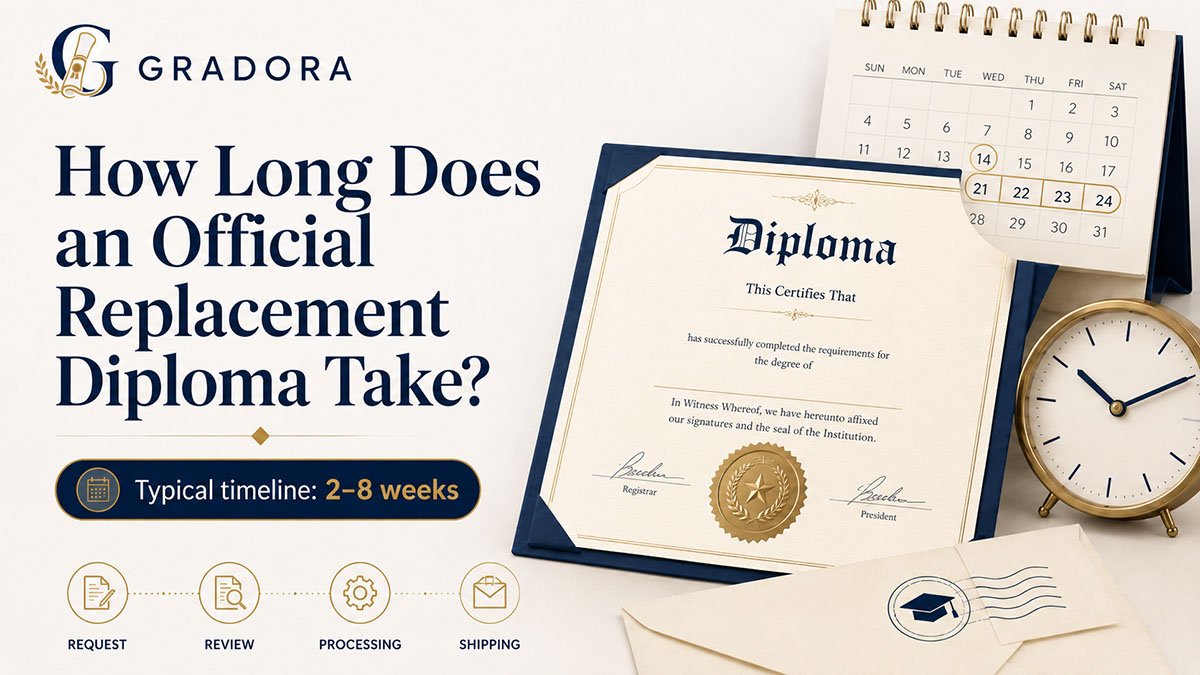
When someone asks us this question, there’s almost always a deadline behind it. A new job starts in three weeks. Grad school orientation is in a month. The hospital credentialing office needs paperwork by the end of the quarter. The honest answer is: it depends on the school, the format you’re requesting, and whether you need expedited service — but for most US institutions, an official replacement diploma takes somewhere between two and eight weeks from the day your request is received.
The longer answer matters, because the difference between two weeks and eight weeks is often the difference between making your deadline and missing it. Below is a realistic breakdown of how long each part of the process actually takes, what speeds things up, what slows them down, and what to do if the timeline doesn’t line up with your situation.
Table of Contents
ToggleThe Short Answer, by School Type
Here’s the range you can realistically expect for an official replacement diploma (not a transcript — those are usually much faster):
| Type of Institution | Typical Processing Time | Notes |
|---|---|---|
| High school (district still active) | 1–4 weeks | Faster if the district has an online request form |
| High school (closed school) | 4–12 weeks | Goes through state Department of Education |
| College / university (standard) | 4–8 weeks | Often printed in batches with current graduates |
| College / university (rush) | 1–3 weeks | If available; usually costs extra |
| Closed college | 6–16 weeks | State higher ed agency or designated custodian |
| International institution | 4–20+ weeks | Highly variable; can be longer if you need credential evaluation |
These are the ranges we see most often in customer conversations and that match published policies from school registrars and state agencies. Your specific situation may fall outside these — old records, unusual paperwork, or backed-up offices can extend things — but this is the realistic baseline.
Why Replacement Diplomas Take Longer Than People Expect
If you’ve never gone through this process, the timelines can feel surprisingly long compared to, say, ordering a copy of your driver’s license. There are a few reasons:
Diplomas are printed in batches. Most colleges and universities don’t print diplomas one-at-a-time. They send orders to the same specialty printer that produces diplomas for current graduates, often in monthly or quarterly cycles. If your request lands right after a batch ships, you may be waiting for the next cycle.
Verification is manual. Registrars are legally required to verify your identity and the underlying record before issuing a new document. For older graduates, this can mean pulling archived records, sometimes from physical storage. There’s no shortcut around this part — and there shouldn’t be, because the verification is what gives the diploma its legal weight.
Signatures and seals. Many institutions require the actual signature of the current president or registrar on replacement diplomas, plus an embossed seal. These aren’t pre-printed in bulk; they’re added per-diploma, sometimes by hand.
Mail time. Once the diploma is printed and signed, it still has to be packaged carefully (these are oversized, often fragile documents) and shipped — usually via tracked mail. Domestic shipping adds 3–7 days; international adds 2–4 weeks.
Closed-school requests add an entirely separate timeline because the state agency or custodian first has to locate the records before the printing process even begins. We’ve written about that situation in detail in What to Do If Your School Closed and You Need a Diploma.
Transcripts Are Usually Much Faster — and Often What You Actually Need
Here’s something worth flagging before you wait six weeks for a paper diploma: for most employment, licensing, and admissions purposes, what’s actually verified is an official transcript, not the physical diploma. Background check companies, HR departments, and admissions offices generally accept transcripts as proof of completion.
Transcripts are dramatically faster:
- Most US colleges deliver transcripts through the National Student Clearinghouse, often electronically, within 24–72 hours.
- High school transcripts typically take 3–10 business days.
- Closed-school transcripts (from state custodians) usually take 2–6 weeks — still faster than diplomas in most cases.
We’ve watched people spend weeks waiting on a replacement diploma when a transcript would have closed their employment verification before the diploma was even printed. Before you commit to the longer wait, call the requesting party — the employer, school, or licensing board — and ask whether a transcript or verification letter is sufficient. It almost always is.
What Speeds Things Up
If you’re against a deadline, a few things genuinely shorten the timeline:
Request expedited / rush processing if it’s offered. Many universities have a rush option — usually 1–3 weeks instead of 4–8 — for an extra fee (often $50–$150). Not every school offers it, but it’s the first question to ask the registrar.
Use the online request system if available. Mailed-in paper forms add days at every step. Online portals get logged into the queue immediately.
Submit clean, complete paperwork the first time. The single most common cause of delays is a request that comes back for clarification — missing ID, mismatched names (especially maiden vs. married), unclear graduation year. Double-check everything before submitting.
Request a transcript in parallel. If you can, order both at once. The transcript will arrive first and may satisfy your immediate need; the diploma can follow on its own timeline.
Ask for express shipping. Even if production takes 6 weeks, shipping can be 1 day instead of 7 if you pay for it. For deadline situations, this matters.
Get the verifying party to accept alternative documentation. Many employers and admissions offices will accept a “letter of completion” or “verification letter” from the registrar — which is much faster to issue than a reprinted diploma — as a placeholder while the official document is in production.
What Slows Things Down
In our experience, these are the most common things that turn a 4-week wait into a 10-week one:
The school is on break. Registrar’s offices have reduced staff during winter break, spring break, and especially summer. Requests submitted in mid-December often don’t move until mid-January.
The school is between batches. As mentioned, many institutions print diplomas in cycles. If you just missed one, you’re waiting for the next.
You’re an older graduate with archived records. Records that have to be retrieved from offsite storage add 1–3 weeks. This is more common for graduations before about 1990.
Name changes without supporting documentation. If your current legal name differs from your graduation name (marriage, divorce, gender transition, naturalization), expect the registrar to ask for documentation. Sending it preemptively helps.
Mail-in or in-person requirements. A handful of schools still require notarized paper requests or in-person pickup. These add days or weeks just for the paperwork to circulate.
Anything involving multiple parties. If your situation involves a closed school + state custodian + credential evaluator (common for international graduates working in the US), each handoff adds time.
What to Do If the Timeline Doesn’t Work
When the official replacement won’t arrive in time for what you actually need it for, the right move depends entirely on what that need is.
If it’s for employment, licensing, or admissions: call the requesting party directly and explain the situation. A “letter of completion” or verification letter from the registrar is faster to obtain and is usually accepted. Some employers will accept a transcript alone; some will give you a grace period if they know paperwork is in motion. The worst outcome is missing a deadline without telling anyone — most institutions are more flexible than people assume, if you communicate early.
If it’s for a personal milestone: a graduation gift you’re giving, a wall you want to fill, a photo you want to take with it. In that case, the official document isn’t the right tool anyway. A custom display copy is what’s actually built for that purpose — a personalized, framed-ready commemorative piece that arrives in days rather than months. It cannot substitute for the official diploma for any verification purpose, but for display, it does exactly what people are trying to do when they say they want their diploma “back.”
We make display copies for customers in this exact situation — people who’ve already requested the official replacement and want something to actually frame in the meantime, or instead of, framing the original. See our guide on getting a display copy of a diploma or transcript, or our breakdown of how display copies differ from official diplomas.
Frequently Asked Questions
Can I get a replacement diploma the same day? For the official document — almost never. The fastest realistic timeline from any US institution is about one week, and that’s with rush service paid for in advance. Anyone advertising “same-day official diplomas” is either selling transcripts (which is fine, just different) or selling something that isn’t actually official.
What about same-day display copies? Display copies are faster because they don’t go through institutional verification — they’re personalized commemorative pieces from a design studio. Production for a display copy is usually 2–3 days, plus shipping. They are not, however, official documents and cannot be used for verification.
Can a transcript substitute for a diploma? For most verification purposes — yes. Background check companies, HR departments, and admissions offices typically verify graduation through transcripts, not the diploma itself. Call the requesting party and ask before assuming you need the physical paper.
What if I need it for immigration or licensing in another country? You’ll likely need both the diploma (or transcript) and a credential evaluation through WES or another NACES member. Build the credential evaluation timeline (typically 2–6 weeks on top of getting the document) into your planning.
Will paying more actually make it faster? Sometimes. Rush production fees genuinely shorten the registrar’s queue (when offered). Express shipping shortens the mailing time. But you can’t always pay to skip the underlying processes — verification, archive retrieval, and batch printing aren’t always optional, no matter how much you pay.
My deadline is in two weeks and the school says it’ll take six. Now what? Three moves, in this order: (1) Call the registrar and ask explicitly about rush options and verification letters — these aren’t always listed on the website. (2) Order an official transcript in parallel; it’ll likely arrive first and may satisfy your need. (3) Call the requesting party, explain the situation, and ask whether a transcript or letter is acceptable, or whether they’ll grant a short extension. Most are more flexible than the policy page suggests if you communicate early.
Can I track the status of my replacement diploma request? Most registrars provide a request confirmation but not real-time tracking. You can usually call or email for a status update after 2–3 weeks. Save your confirmation number — it makes follow-up dramatically easier.
A Practical Timeline Worksheet
If you’re trying to plan around a real deadline, work backward from the date you need the document:
- 8+ weeks out: Start now. Submit the request, ask about rush options, and order a transcript in parallel as a backup.
- 4–6 weeks out: Submit immediately. Pay for rush processing if available. Notify the requesting party that paperwork is in motion in case they need to extend.
- 2–3 weeks out: Request an expedited transcript or verification letter as your primary document. Order the diploma anyway, but treat it as a follow-up rather than the deadline document.
- Less than 2 weeks: Call the requesting party first to clarify what they actually need. A transcript or verification letter is your fastest realistic option. The framed paper diploma probably isn’t going to arrive in time, but it also probably isn’t what you need.
- Already missed: Don’t disappear. Call the requesting party, explain, and ask for an extension. Most will grant one if you communicate proactively.
If You Want Something to Frame Now
Whether the official document is on its way or whether you’ve already received it and just want a clean, custom version to actually display — a display copy is built for exactly that. THEGRADORA makes custom keepsake diplomas designed for the wall, the gift, or the shelf. They’re not, and never will be, a replacement for the official document — but for display, they do exactly what people are usually trying to do when they say they want their diploma “back.”
Browse the shop, start a custom order, or read the complete guide to custom diploma and certificate keepsakes for the bigger picture.
THEGRADORA products are custom keepsakes intended solely for novelty, display, commemorative, and personal use. They are not official academic records and must not be used for employment verification, academic admission, professional licensing, identity verification, or any misleading purpose. For an official replacement diploma or transcript, always contact your school’s registrar or your state’s Department of Education.