
Last updated: 2026 · Verified against current state Department of Education procedures
If you need to prove you graduated from high school — for a job, a college application, a security clearance, an immigration case, or a professional license — you don't actually need your diploma. You need your transcript.
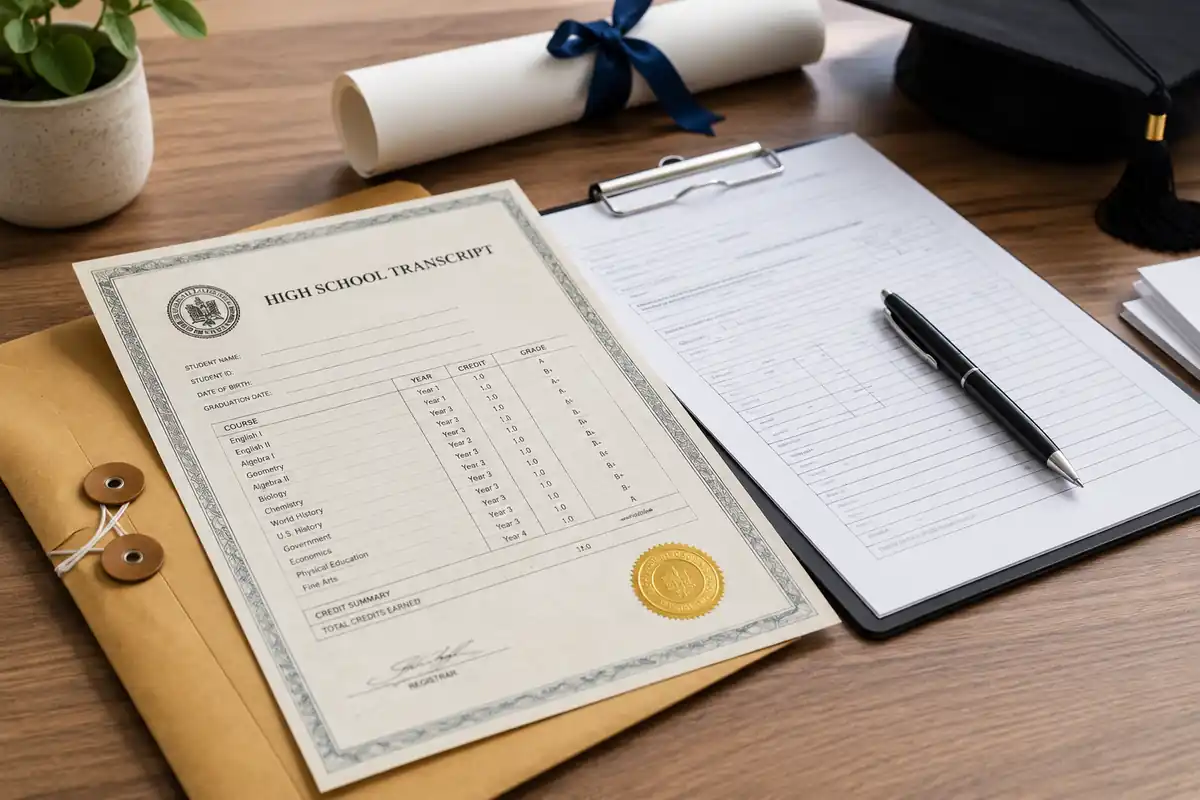
The transcript is the document employers, colleges, and government agencies actually verify against. It lists your courses, grades, GPA, attendance, and graduation date in a format that's legally recognized as your official academic record. The diploma is the ceremonial certificate you hang on the wall.
This guide walks you through exactly how to get a replacement high school transcript in 2026 — the fastest paths, the realistic timelines, the actual costs, and what to do when the standard process doesn't work. If you've also lost your diploma itself, request both at the same time — most districts process them together for almost the same cost.
Table of Contents
ToggleThe Short Answer: Where to Start in 24 Hours
The fastest path to a replacement high school transcript:
- Identify your school district. The district holds your transcript, not the individual school. Use the NCES School Locator to find the current district.
- Search for "[district name] transcript request" or "[district name] alumni records."
- Choose your delivery method: electronic (faster, usually 1–3 business days) or paper (slower, 1–4 weeks). Electronic transcripts are accepted by almost all employers and colleges in 2026.
- Submit your request with full legal name at graduation, date of birth, graduation year, and government-issued photo ID.
- Pay the fee (typically $3–$15 per copy) and specify where the transcript should be sent — directly to an employer or college (sealed, official), or to yourself (often issued as "unofficial").
If your school has closed, the process is different — see the dedicated closed-school records guide. If you also need your diploma, see the lost high school diploma guide and request both together.
Diploma vs Transcript: Which One Do You Actually Need?
This is the question that determines everything else. Most people requesting a "replacement diploma" actually need a transcript — they just don't know it. Here's how to tell which you need:
You need a transcript if:
- An employer is verifying your graduation as part of a background check
- A college or trade school is reviewing your admissions application
- You're applying for a professional license that requires educational verification
- You're enlisting in the military
- You're applying for immigration benefits or citizenship
- You need to provide proof of high school completion for federal financial aid
- You're transferring credits or applying to graduate school
You need a diploma if:
- You want to display it on a wall
- You want to give it as a gift or commemorative item
- An institution has explicitly requested the diploma document itself (rare)
- You need it for a personal milestone or family record
In about 95% of real-world verification scenarios, the transcript is what's actually needed. The diploma is ceremonial. If you're unsure what an employer or institution wants, ask them specifically — many people unnecessarily wait weeks for a replacement diploma when a transcript would have been accepted in days.
Step-by-Step: How to Request Your Replacement Transcript
Step 1: Confirm the correct school district
The district that currently administers your former high school holds your transcript, even if the school has been renamed, restructured, or merged. The NCES School Locator will identify the current district.
If the school has closed entirely, see the closed school records guide for the alternate process.
Step 2: Locate the transcript request page
Most school districts now use one of three transcript request systems:
- Parchment — the largest electronic transcript vendor in the U.S., used by tens of thousands of school districts and universities
- ScribOrder — common for district-direct transcript requests, often paired with diploma replacement
- The district's own online portal — increasingly common for large districts, sometimes integrated with student information systems
Search the district's main website for "transcripts," "alumni records," or "student records." Common URL patterns:
[district].org/transcripts[district].parchment.com[district].scriborder.com
If you can't find a transcript request page, call the district records office. Avoid going through the individual school — districts handle transcript requests centrally.
Step 3: Choose electronic or paper delivery
Electronic transcripts have become the standard in 2026. They're:
- Faster. Typically delivered in 1–3 business days, sometimes within hours.
- Verifiable. Delivered as encrypted PDFs that recipients can validate digitally.
- Cheaper. Usually $3–$10 per copy versus $5–$20 for paper.
- Universally accepted. Virtually all employers, colleges, and government agencies now accept electronic transcripts.
Paper transcripts are still required in a handful of cases: some older licensing boards, some international document chains, and any process that explicitly requires a "wet seal" or original ink signature. If you're not sure, ask the recipient before paying for paper.
Step 4: Gather your documentation
You'll typically need:
- Full legal name at the time of graduation (maiden names, hyphenated names, suffixes)
- Current legal name if it has changed
- Date of birth
- Year of graduation
- Student ID number (if you remember it — most districts can look it up without)
- Government-issued photo ID
- Proof of name change if applicable (marriage certificate, court order, divorce decree)
- The recipient's exact name and address (or email address for electronic delivery)
Step 5: Specify who receives the transcript
This is the step most people get wrong. Transcripts have two delivery types:
Official transcript: Sealed, sent directly from the school district to the recipient (employer, college, licensing board). The recipient sees an unbroken seal or digital chain of custody, which verifies authenticity. This is what employers and colleges require for verification.
Unofficial transcript: Sent to you. Useful for your personal records, applications you're filling out yourself, or as a reference copy. Not typically accepted for formal verification.
If you need an official transcript for an employer or college, request it sent directly to them. If you request one sent to yourself and then forward it, it loses its "official" status.
Step 6: Pay and submit
Fees are usually $3–$15 per copy, with shipping or expedited processing as add-ons. Most districts accept credit card payment online. Some still require check or money order, especially for paper requests.
Step 7: Track delivery
Electronic transcripts arrive quickly — usually within 1–3 business days, often the same day. Paper transcripts take 1–4 weeks depending on shipping. If you haven't received confirmation within the stated turnaround, contact the records office. Email delivery occasionally fails, addresses occasionally get misread, and you don't want to find out three weeks before a deadline.
Realistic Timelines: How Long Does a Transcript Take?
Transcript turnaround in 2026 is significantly faster than diploma replacement because most are issued electronically.
Electronic transcripts via Parchment or similar vendors: 1–3 business days, sometimes within hours. Many large districts process electronic requests in real time during business hours.
Paper transcripts from large public districts: 1–2 weeks for processing, plus shipping time.
Paper transcripts from smaller districts: 2–4 weeks. Smaller districts often process requests in batches.
Transcripts from private schools: Highly variable. Some private schools process within 1–2 weeks; others, especially small ones, can take 4–6 weeks.
Transcripts for older graduates (20+ years out): May require archive lookup, adding 1–3 weeks. Districts maintain permanent records, but older records may be archived off-site or on microfilm.
Summer slowdowns: Many districts close records offices during summer break (mid-June through late July). If you can wait until August, you'll often get faster service.
Rush options: Most districts offer expedited processing for transcripts (less common for diplomas). Rush fees typically range $15–$50 and can cut turnaround to 1–2 business days for paper, or same-day for electronic.
How Much Does a Replacement Transcript Cost?
Transcript costs in 2026:
Electronic transcripts:
- Single copy: $3–$10
- Multiple copies: often discounted (e.g., $5 first, $2 each additional)
- Rush delivery: usually no additional charge for electronic
Paper transcripts:
- Single copy: $5–$15
- Shipping: $5–$25 depending on method (USPS, FedEx, international)
- Rush processing: $15–$50 extra
Bundled with replacement diploma: If you need both, ordering together usually saves money. Combined fees typically run $20–$60.
International delivery and authentication: If you need the transcript for use in another country, factor in Apostille certification ($40–$100) plus international shipping ($20–$60).
One caution: third-party transcript services that charge $50–$150 to "expedite" a request are usually just forwarding it to the same district you'd contact directly. The district controls the actual processing time. Always start with the district itself.
What If Your School Has Closed?
Closed-school transcripts follow a different process. Records are transferred to the absorbing district, the county Regional Office of Education, or the state Department of Education's archive, depending on the type of school and the state.
Transcripts are typically easier to retrieve from closed schools than diplomas — they're more frequently digitized and archived in searchable databases, and most state archives can issue transcripts even when they can't reissue the diploma itself.
See our closed school records guide for the full process, including state-by-state archive contacts.
State-by-State Resources: Transcript Request Portals
Below are direct links to official .gov resources for high school transcripts in major states. If your state isn't listed, search "[your state] department of education student records" or "[your state] high school transcript request."
California
The California Department of Education does not store individual transcripts. Contact the school district directly. Use the California School Directory linked from cde.ca.gov/re/di/ to find your district.
Texas
The Texas Education Agency does not store individual transcripts — requests go to the district. For Public Information Requests on records access: tea.texas.gov/about-tea/contact-us/public-information-requests.
Florida
For traditional high school transcripts, contact the school district directly. For state-issued HSE diplomas and transcripts: fldoe.org/academics/career-adult-edu/hse/transcript-diploma-requests.stml.
Georgia
For traditional transcripts, contact your school district. For GED/HSE transcripts: Technical College System of Georgia at tcsg.edu/adult-education/adult-education-high-school-equivalency-hse/ged-testing/request-a-ged-transcript.
New York
NYSED does not hold high school transcripts. Contact your school district. For HSE transcripts: acces.nysed.gov/hse/high-school-equivalency-duplicate-diploma-andor-transcript-requests.
New Jersey
NJ Department of Education Adult Education unit handles HSE/GED transcripts: nj.gov/education/adulted/verification/. Traditional district transcripts come from the school district.
South Carolina
SC Department of Education online ordering portal: doesc.scriborder.com. Note that SC explicitly states the state Department of Education does not house high school transcripts — those must come from the district.
Illinois
HSE transcripts: Regional Offices of Education at $10 per copy, iccb.org/illinois-hse/. Traditional transcripts come from the school district.
For all other states: Start at the NCES School Locator, then search your state's .gov Department of Education website for "student records" or "transcript request."
When You Need a Diploma Copy Alongside Your Transcript
The transcript handles the legal and verification side. But many people still want a physical diploma — for the wall, for family members, for milestone displays — even when an official replacement isn't being requested or hasn't arrived yet.
If the transcript is enough to prove graduation for your immediate need (employment, college, license) but you also want a physical diploma to display, some families order a high-quality keepsake replica for memorial or decorative purposes. At THEGRADORA, we hand-craft commemorative replicas in our Savannah, GA workshop, clearly marked as keepsake replicas and intended exclusively for display, novelty, and personal records. They're popular for:
- Display purposes when the verification need is handled by the transcript and you just want something for the wall
- Memorial displays for deceased family members whose original diplomas were lost
- Family heritage walls commemorating multi-generational graduations
- Decorative use in home offices, memory rooms, or shadow boxes
Browse our diploma keepsake display options to see styles approximating common public and private school templates. These are explicitly not official documents and don't replace the transcript or official diploma. They serve a display purpose alongside whatever official documentation you've requested from your school district.
Common Transcript Problems and How to Fix Them
Problem: The district says they have no record of me
This usually means a name mismatch or a search error. Verify your full legal name at graduation (including any spelling variations, middle initials, or hyphenations). If you graduated under a maiden name and have since married, the records are still under the maiden name. Resubmit with the original name and provide marriage certificate as bridge documentation.
If the district still can't find you, ask them to check archived records or off-site storage. Older records may not be in the active database.
Problem: The transcript shows incorrect information
Transcripts occasionally have errors — wrong grade in one class, wrong graduation date, missing courses. Districts have a process for correcting transcripts, but it requires evidence: report cards, course records, or affidavits from teachers. Contact the district registrar to start a correction request. Expect 4–8 weeks for review.
Problem: I need an official transcript but the recipient won't accept electronic
Some older institutions, especially international ones, still require paper transcripts with original seals. Most districts can issue both — request electronic for fast use and paper for the holdout recipient.
Problem: My transcript needs to be authenticated for use in another country
You'll need either an Apostille (for Hague Convention countries) or Great Seal authentication (for non-Hague countries). Order the official paper transcript first, then submit it to your state's Secretary of State office for authentication. Budget an extra $40–$100 and 2–4 weeks.
Problem: The district has unpaid fees on my account
Some districts will refuse to release transcripts until outstanding balances are paid. If your request is rejected for this reason, the records office will tell you exactly what's owed. Pay it and resubmit. This is more common with private schools and post-secondary institutions than with public K-12 districts.
FAQ
What's the difference between an official and unofficial transcript?
An official transcript is sealed and sent directly from the school district to the recipient, preserving a verifiable chain of custody. An unofficial transcript is sent to you and is typically only accepted for personal reference, not for formal verification.
How long does a high school transcript take?
Electronic transcripts typically arrive in 1–3 business days. Paper transcripts take 1–4 weeks. Closed-school transcripts can take 4–12 weeks due to archive lookups.
How much does a replacement transcript cost?
Electronic transcripts run $3–$10 per copy; paper transcripts run $5–$15 plus shipping. Rush processing typically adds $15–$50. Multi-copy discounts are common.
Do I need a transcript or a diploma to prove I graduated?
For employment, college, military, professional licensing, and immigration, you need a transcript. The diploma is ceremonial — it's what you hang on the wall, not what verifiers check.
Can I get an electronic transcript instantly?
Often yes — many large districts process electronic transcript requests within hours during business days. Rush fees usually aren't required because electronic delivery is already fast.
Can I order both a transcript and a replacement diploma at the same time?
Yes, and you should if you need both. Most districts process them together and offer bundled pricing. See the lost high school diploma guide for the diploma side of the process.
What if my high school has closed?
Closed-school transcripts follow a different process. Records are transferred to the absorbing district, county Regional Office of Education, or state archive. They're usually easier to retrieve than closed-school diplomas because they're more frequently digitized.
Will employers actually accept an electronic transcript?
Yes. Electronic transcripts are the standard format accepted by virtually all employers, colleges, and government agencies in 2026. The encrypted PDF format provides stronger verification than paper.
What if my name has changed since graduation?
Submit the request under your graduation name and include proof of name change (marriage certificate, court order). The transcript will be issued under your graduation name. Some districts will issue a supplementary verification letter confirming the name change.
Can someone else request my transcript for me?
Only with proper legal authority — power of attorney, court order, or a signed FERPA release from you. For deceased relatives, you need a death certificate plus proof of relationship and legal authority.
How far back do transcripts go?
Indefinitely. School districts are required to maintain permanent academic records. Transcripts from the 1950s, 1940s, and earlier are routinely retrieved — they may be on microfilm and take longer, but they exist.
Can a transcript replace the diploma for verification purposes?
Yes, in nearly all cases. Employers and institutions verify graduation through the transcript, not the diploma. If you need to display a diploma but the transcript handles verification, keepsake replicas exist for that display purpose — they don't replace the transcript or any official document.
This guide reflects publicly available 2026 procedures from state Departments of Education and school district records offices. Always verify the current process directly with the issuing district before submitting payment.