
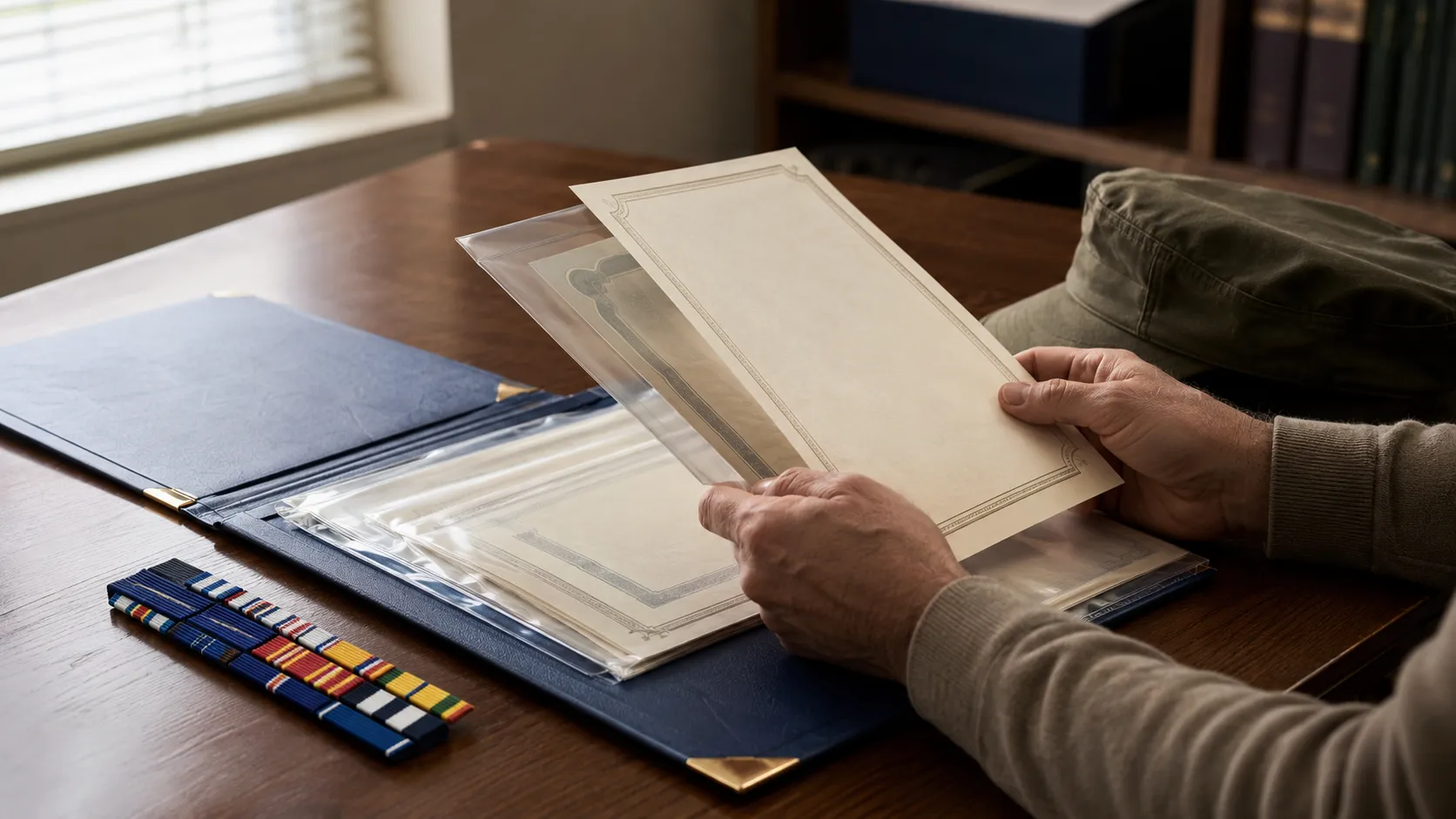
Military life is hard on paperwork. You PCS six times in twelve years, everything you own gets boxed and shipped and boxed again, and somewhere along the way the folder with your high school diploma stops turning up. Or it got soaked in a storage unit in Georgia. Or your mom had it and she moved. Or you enlisted at eighteen and honestly never had it in the first place.
Then you separate, start applying to schools or jobs, and someone asks for proof of education. Now you need to reconstruct a paper trail that's been scattered across a decade and several states.
Good news: service members and veterans actually have more paths to their records than most civilians do, because the military generates its own parallel documentation. The tricky part is that there are several different documents, they do different things, and most people don't know which one they actually need. Let's sort that out.
Table of Contents
ToggleThe documents you might be looking for
Before chasing anything down, figure out which document solves your problem. There are four in play, and they're not interchangeable.
Your high school diploma or GED. The civilian credential from before you enlisted. Held by your old school district or, for a military-administered GED, potentially by DoD records. This is what you need when someone specifically asks for proof of secondary education.
Your DD214. Your discharge paperwork. It proves your service, character of discharge, and dates — and depending on the version, it may list your education level. It's not a diploma, but it's often accepted as supporting documentation and it's required for a huge range of veteran benefits.
Your Joint Services Transcript (JST). This is the one a lot of veterans don't know about. The JST translates your military schooling, training, and work history into civilian academic terms — as a standardized transcript colleges can actually read and award credit for. If you're heading to school, this is potentially worth real money in transferred credits.
College or trade credentials earned during or after service. Degrees and certificates from civilian institutions, held by those schools' registrars like anyone else's.
Most people asking "how do I get my military diploma" actually need some combination of the JST and their old high school diploma — not one magic document.
Getting your high school diploma replaced
If the credential you're missing is your pre-enlistment high school diploma, the military can't help you with that one. It's a civilian document held by a civilian school district, and you go get it the same way anyone else does.
The short version: find the school district that currently administers your old high school, contact their records office, provide ID and your graduation details, pay a fee (usually $10–$50), and wait a few weeks. Our lost high school diploma guide walks through the whole thing, including how to find the right district when your school has been renamed or absorbed.
Two military-specific wrinkles worth flagging:
Your ID situation. Districts want a government-issued photo ID. Your military ID or CAC works fine for this at most districts, as does a VA ID card or a driver's license. If you're deployed or stationed overseas and can't easily produce a notarized copy, call the district and ask what they'll accept — many will work with you.
Your name may have changed. Marriage, legal name changes, or just the difference between the name on your enlistment paperwork and the one on your diploma. Request under the name you graduated under and bring documentation to bridge them. Our guide to name changes on a diploma covers how that works.
Getting your DD214
You got a copy at separation. If it's gone, you can request a replacement — and it's free.
Veterans and next of kin can get free copies of the DD214 and other service records through the National Archives. The fastest route is the eVetRecs online tool, which the VA points veterans to directly. You'll need to sign in with an identity-verified ID.me account, and the Archives may ask for a live selfie photo as an extra verification step. You can also request by mail or fax if online isn't workable.
One useful note if you're applying for VA benefits: you don't need to chase this down yourself. The VA requests your DD214 for you when they receive your application.
For more recent service, there's also milConnect, where many veterans can pull a copy of their DD214 directly.
Getting your Joint Services Transcript
This is the one worth knowing about even if nobody's asked you for it, because it can convert your military training into college credit.
The JST covers members of the Army, Marine Corps, Navy, and Coast Guard — active duty, reserve, and veterans. Air Force and Space Force members go a different route: Air Force personnel order official transcripts through the Community College of the Air Force / Air University via Parchment instead.
To request one, go to the JST website and register for an account. If you no longer have a CAC or a card reader, you can register for a JST account without one. Once you're in, the Transcripts tab has an official transcript request option.
An important detail that trips people up: official JSTs can't be sent to individuals. They go directly to the educational institutions you designate. If you just want to see what's on yours, you can pull an unofficial copy for review — but for admissions purposes, the school has to receive it directly from JST.
Worth reviewing your JST for accuracy before sending it anywhere, too. Corrections and updates go through the JST Operations Center, and each branch has its own procedure for submitting supporting documentation.
A wrinkle for older veterans: pre-1974 GED records
If you took the GED through the military before September 1974, your records may live somewhere unexpected. USAFI (United States Armed Forces Institute) and GED transcripts are available through the JST system for U.S. military personnel tested before September 1974, Fort Jackson personnel tested before June 30, 1974, and Coast Guard personnel tested before January 1975.
These old USAFI transcripts sometimes contain score data for tests that may still be worth college credit — which is a nice surprise for veterans who assumed anything from that era was long gone.
When you're the family member doing this
A lot of these requests come from spouses, adult children, or next of kin rather than the veteran themselves — sometimes because the veteran has passed away and the family is settling affairs or assembling a memorial.
Next of kin can request DD214s and service records from the National Archives for free, same as veterans. For a deceased service member you'll generally need a death certificate plus proof of your relationship, and depending on what you're requesting, proof of your legal authority.
School district records for a deceased veteran's high school diploma follow the same rules as any deceased person's records — death certificate, proof of relationship, and often proof of legal authority like an executor letter. Districts vary on what they'll release and to whom, so call first.
What actually gets verified (and what doesn't)
Something worth understanding before you spend weeks assembling documents you may not need.
When an employer or school verifies your education, they're almost never examining a physical diploma. They query the school's records database, or use a verification service, or ask for an official transcript sent directly from the source. That's true for civilian credentials and it's true for the JST — which is precisely why official JSTs go straight to institutions rather than through your hands.
The practical takeaway: if someone needs to verify your education, focus on transcripts and official records requests, not on getting a physical diploma in your hands. The diploma matters for other reasons — which brings us to the wall.
The wall, and what goes on it
Plenty of veterans want a physical diploma not because anyone's asking for one, but because they want it up on the wall. Alongside the shadow box, the flag case, the ribbons, the unit patches, the DD214 in a frame. It belongs in that arrangement, and for a lot of service members the high school diploma carries specific weight — it was the thing that came before everything else, sometimes finished under difficult circumstances, sometimes the last civilian milestone before enlisting.
If the official replacement is coming, great — order it from your district and frame it. But there are cases where that doesn't work out: the school closed, the records are genuinely gone, the veteran has passed and no official replacement is obtainable, or the family wants a matching display across several generations of service and older documents simply don't exist anymore.
In those cases some families order a keepsake replica for the display — clearly a commemorative piece, not an official document. It can't be used to verify anything and it isn't meant to; it just fills the frame in a shadow box or on a memory wall. Our replacement vs replica diploma explainer covers the distinction, and our memorial diploma keepsakes guide gets into the family memorial side of it specifically.
For the display itself — framing, placement, keeping documents from degrading — our guide to displaying your diploma at home covers the practical side, including why archivists generally recommend keeping originals stored and displaying copies.
FAQ
How do I get a replacement high school diploma if I'm in the military?
Same as anyone else — through the school district that issued it. The military can't reissue a civilian high school diploma. Your military ID or CAC works as the photo ID most districts require, and if you're deployed, call the district and ask what they'll accept.
Is my DD214 the same as a diploma?
No. The DD214 documents your service — dates, discharge character, and depending on the version, education level. It's often accepted as supporting documentation, but it's not a diploma and won't substitute for one when a school or employer specifically wants proof of secondary education.
How do I get a replacement DD214?
Free through the National Archives, either online with the eVetRecs tool (you'll need an identity-verified ID.me account) or by mail or fax. Many veterans can also pull a copy through milConnect. And if you're applying for VA benefits, the VA requests it for you — no need to do it yourself.
What is a Joint Services Transcript and do I need one?
It converts your military training and experience into civilian academic terms so colleges can award credit for it. If you're going to school, absolutely worth getting — it can save you real time and tuition. Available to Army, Marine Corps, Navy, and Coast Guard members. Air Force and Space Force go through Air University instead.
Can I get a copy of my JST sent to me directly?
Not an official one — official JSTs go directly to the educational institutions you designate, not to individuals. You can pull an unofficial copy to review what's on it, which is a good idea before sending it anywhere.
I took the GED in the military in the 1970s. Are those records gone?
Probably not. USAFI and GED transcripts for military personnel tested before September 1974 are available through the JST system (with slightly different cutoff dates for Fort Jackson and Coast Guard personnel). Those old records sometimes even contain scores worth college credit.
Can my spouse or family request my records?
Next of kin can request DD214s and service records from the National Archives. For a deceased service member, expect to provide a death certificate and proof of relationship, and sometimes proof of legal authority. School districts have their own rules for releasing a deceased person's records — call first.
Does my military ID work as identification for a diploma request?
At most districts, yes — a military ID or CAC counts as government-issued photo ID. A VA ID card or driver's license works too. If you're overseas and can't easily notarize a copy, call the district and explain; many will work with you.
What if I enlisted before finishing high school?
Then there's no diploma to replace, and what you want is a GED or HiSET. Both are recognized nationwide, and there are education programs and benefits available to service members and veterans specifically for this. Your installation's education office or a Military OneSource education consultant can point you to the right program.
My school closed while I was in service. Now what?
Records get transferred to the absorbing district, county education office, or state archive — they're rarely actually lost. Our closed school records guide walks through tracking them down.
Do employers verify against my physical diploma?
Rarely. They query school records databases, use verification services, or request official transcripts sent directly from the source. That's why official transcripts and the JST route through institutions rather than through you.
Can I frame a replica of a diploma for a shadow box display?
For display, yes — a keepsake replica is a decorative commemorative piece. It can't be used to verify anything and shouldn't be presented as an official document. It's for the wall, in the shadow box, alongside the flag and the ribbons.
Procedures for military and veteran records change periodically, and each branch has its own quirks — always check the current process directly with the National Archives, the JST Operations Center, or your branch's education office. And if you're actively serving, your installation's education office is genuinely the fastest shortcut for most of this.
This is part of our broader coverage of replacing and obtaining official educational documents. For the full picture, see our complete replacement educational documents guide.