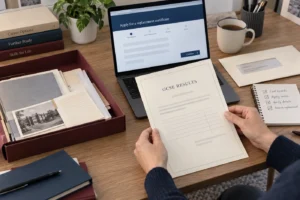

If you have lost your degree certificate, do not order the first document you find online and do not assume that you must wait for a new paper certificate before you can move forward. First, confirm why you need proof of the degree. Then contact the university or other institution that awarded it and ask which record fits that purpose: a replacement certificate, academic transcript, award letter, secure digital credential or direct verification.
What to do now: search once carefully, save any scans or old academic records you still have, identify the awarding institution, ask the recipient what evidence it accepts, and use the institution’s current records service. If a job, admission, visa or professional deadline is close, request an interim form of proof instead of waiting silently for a paper replacement.
A lost degree certificate does not erase your degree. The underlying academic record is normally held by the awarding institution or its authorised records provider. The piece of paper is evidence of that record, but it is not the record itself. That distinction is useful because it gives you more than one possible route when time matters.
This guide concentrates on the decisions you need to make immediately after discovering the loss. It covers searching, identity protection, urgent proof, digital records, renamed or closed institutions, overseas use and what to do if the original later turns up. For a detailed UK application process, including typical documents, fees and university procedures, use our separate guide to getting a replacement degree certificate in the UK.
First, Make Sure the Degree Certificate Is Really Lost
It sounds obvious, but a focused search can save weeks of administration. Degree certificates are often stored with passports, birth certificates, transcripts, graduation photographs, mortgage papers or tax records rather than with everyday files. They also get left inside presentation folders, frames, moving boxes and luggage used after graduation.

Search methodically instead of repeatedly checking the same drawer. Work through the places where the certificate was last used and the people who may have handled it:
- document folders, home safes and locked filing cabinets;
- graduation folders, photograph boxes and frames;
- scanned-document folders, email attachments and cloud storage;
- job, immigration, licensing or university application files;
- parents’ or relatives’ homes if documents were stored after graduation;
- an employer, solicitor, translator, notary or application adviser who received it;
- luggage and boxes used during a recent move; and
- the postal or courier tracking history if it was recently sent somewhere.
If another organisation had the certificate, ask for the name of the person who received it, the date it was returned and any tracking number. A vague answer such as “we posted it” is not enough when the document contains your full name, institution and qualification details.
Do not postpone an urgent application while you search indefinitely. Give yourself a reasonable, fixed period, then begin contacting the awarding institution. You can stop a replacement request later if the original appears and the institution allows cancellation, but a deadline missed during an endless search is harder to fix.
If It May Have Been Stolen, Treat It as a Personal-Information Issue
A degree certificate is not usually enough on its own to take over your identity, but it contains information that can make impersonation more convincing. It may show your full name, university, qualification, classification, award date, certificate number and signatures. Combined with information from social media or a data breach, those details may be misused.
If a bag, home file or shipment was stolen, record what happened. Keep the police or courier reference if one exists. Tell the university that the certificate was stolen rather than merely misplaced, because its declaration requirements may differ. If other identity documents disappeared at the same time, follow the issuing authority’s process for those documents as well.
Be cautious about publishing a clear photograph of the missing certificate in a public post. Sharing the institution and general award can help friends identify it, but there is rarely a good reason to expose a certificate number, signature, student number, date of birth or machine-readable security element.
Useful habit: keep a private note of the loss date, where the certificate may have disappeared, which organisations had access to it and every reference number you receive. This creates a simple timeline if the university asks for a declaration or the original later reappears.
Decide What You Actually Need to Prove
People often say, “I need my degree certificate,” when the receiving organisation actually needs something else. An employer may want confirmation of the degree and award date. A university may need a full transcript showing modules and marks. A licensing body may insist that verification comes directly from the institution. An overseas authority may require a certified copy, translation or apostille.
Before paying for anything, ask the recipient these questions:
- Do you require the paper certificate, or will a secure digital credential be accepted?
- Would an academic transcript or award-confirmation letter satisfy the requirement?
- Must the document be sent directly by the university?
- Do you use a named verification service?
- Will you accept temporary proof while a replacement is being processed?
- For overseas use, must the document be translated, notarised or legalised?
- Is there a deadline and, if so, what happens if institutional verification is pending?
This short conversation prevents a common mistake: paying for a replacement certificate, waiting for delivery and then discovering that the organisation wanted a transcript or direct verification instead.
For a job application
Ask the employer or screening company whether it can verify the degree directly. A scan may be enough at the initial application stage, while formal screening may require consent for the university or a recognised verification provider to confirm the record. Do not alter an old scan to make it look clearer or more current. If the recipient needs source verification, let the source provide it.
For further study
Admissions teams frequently need a transcript as well as evidence that the award was completed. The transcript may contain the course units, credits, grades and final classification that a certificate does not. Ask whether the institution accepts a secure electronic transcript and whether it must arrive through a named platform.
For immigration or professional registration
Follow the exact document rules for the application. A general letter that satisfies an employer may not satisfy a regulator or immigration authority. Check whether the authority wants an original, a replacement, a certified copy, a transcript or verification sent directly by the awarding institution. Do not rely on informal advice from forums when the receiving authority publishes its own requirements.
For your own records or personal display
If there is no employment, admission, licensing, immigration, identity or verification purpose, your priorities may be different. You may simply want something for a frame, family presentation, graduation photography or personal remembrance. Keep that personal-use route separate from the institution-issued records route; the documents do not serve the same function.
Contact the Institution That Awarded the Degree
The right contact is usually the university registrar, student records office, examinations office, awards team or alumni records service. Start on the institution’s main website and search for phrases such as “replacement degree certificate”, “award documents”, “alumni records”, “transcripts” or “degree verification”. Beginning from the main domain helps you avoid outdated forms and unrelated sellers.
Do not assume that the campus where you studied was the awarding body. A college may teach a course that leads to a degree issued by a partner university. In the UK, GOV.UK explains that not every college teaching a degree can award it and that the awarding higher education institution may be different from the teaching institution. Its guidance on checking who can award a degree is a useful starting point when the names differ.
Old transcripts, results letters, student emails, graduation programmes and even photographs of the missing certificate may identify the awarding institution. Look for wording such as “awarded by”, “conferred by” or “degree of”. If the relationship is still unclear, ask the teaching college which organisation held degree-awarding powers in your graduation year.

When you contact the institution, include enough information for the records team to locate you without sending unnecessary sensitive documents in an ordinary email. A useful first enquiry normally includes:
- your full name while enrolled and any former names;
- your current name;
- date of birth, if the institution requests it through a secure route;
- student or candidate number, if known;
- course title and qualification;
- attendance and graduation years;
- college, faculty or campus;
- a brief explanation of the loss; and
- the deadline and type of evidence required.
Wait for the institution to tell you which identity documents it accepts and how to send them. A passport or driving licence should not be attached to an unverified email address simply because a search result asked for it.
Ask About More Than a Paper Replacement
A new paper certificate is only one possible outcome. Depending on the institution, graduation year and country, other records may be available sooner or may fit the recipient’s needs better.
Academic transcript
A transcript generally gives more detail than a certificate, including modules, marks, credits or academic periods. It may also state the final award. For admission or credential evaluation, it is often the more useful document.
Award or degree-confirmation letter
This letter confirms what the institution’s records show. It may include your name, award, classification, award date and attendance dates. Ask the recipient whether a digitally signed letter or one sent directly from the institution is acceptable.
Secure digital credential
Some institutions issue digital academic records that can be shared through a controlled link or wallet. These are not the same as emailing a photograph or PDF scan. The recipient may be able to check the issuer, document status and tamper evidence through the platform.
Direct degree verification
Verification answers the recipient’s question without giving you another paper certificate. It can be useful when an employer, regulator or university wants confirmation from the source. Consent requirements and available data vary, so use the method nominated by the awarding institution.
A sensible request is: “My degree certificate is missing and I need evidence by [date]. Which of your services can provide acceptable proof soonest?” That is more useful than asking only whether the institution can print a duplicate.
What If You Need Proof of Your Degree Urgently?
Contact both sides: the institution that holds the record and the organisation waiting for evidence. Give the exact deadline and ask what temporary or electronic evidence is available. Urgency does not make an unrelated document suitable, but it may change which institution-issued record is most practical.

Possible interim routes include:
- a secure electronic certificate or digital award document;
- an academic transcript confirming the completed award;
- an award-confirmation letter on institutional letterhead;
- an email sent directly from the records office to the recipient;
- verification through the institution’s nominated platform;
- a receipt showing that a replacement request is in progress, if the recipient agrees; or
- a conditional extension while source verification is completed.
Put the agreement in writing. If an admissions officer says a transcript is acceptable until the replacement arrives, save that email with your application records. The document accepted for one process may not be accepted for another.
Be wary of anyone promising an institution-issued replacement in hours without access to the institution’s records. Fast printing and fast verification are not the same thing. The records holder must confirm the award when the document will be used as evidence.
How the Next Step Differs by Country
The basic principle is consistent: begin with the awarding institution. The available platforms and terminology, however, vary by country and institution.
United Kingdom
Contact the degree-awarding university, which may offer a replacement certificate, transcript, confirmation letter or direct verification. UK institutions may also participate in Hedd, a service used by approved employers, agencies and other organisations to check higher education awards with the graduate’s consent. Hedd is a verification route, not a shop that sends graduates a replacement certificate.
If you need the complete UK replacement process, the UK guide linked near the beginning of this article covers the application steps without forcing this article to repeat them.
United States
Start with the registrar or records office of the degree-granting college or university. The school may handle diploma reorders itself or direct alumni to an authorised provider. For verification, the National Student Clearinghouse confirms degrees and attendance for participating US institutions. It expressly notes that its verification services do not provide copies of degrees or diplomas, which is a useful reminder that verification and replacement are separate requests.
Australia and New Zealand
Ask the awarding university about a replacement testamur, academic transcript or digital record. My eQuals is governed and operated by participating Australian and New Zealand education providers and allows learners to view and share certified tertiary credentials. If your record is available there, a secure share may solve an urgent evidence problem even when the paper document is missing.
Canada
Contact the registrar at the college or university and ask whether the institution uses a digital credential network. MyCreds, led by the Association of Registrars of the Universities and Colleges of Canada, provides a secure learner wallet for participating institutions’ transcripts, diplomas and other academic records. Availability depends on the institution and record, so check the network members and your school’s instructions.
Other countries
Use the same sequence: identify the awarding body, enter through its main website, find its alumni or records service, and ask the recipient what proof it recognises. Ministries, national qualification authorities or institution registers can help when you are unsure who holds the records, but they do not automatically replace a university certificate.
What If the University Changed Its Name, Merged or Closed?
A changed name does not normally erase the academic record. Search both the former and current institution names together with “records”, “transcript”, “alumni” and “replacement certificate”. Merger announcements, regulator registers and archived university pages may identify the successor institution.
If the institution closed, look for the organisation appointed to hold its student records. Depending on the country, that may be a successor university, government education department, regulator, archive, court-appointed custodian or transcript service. The teaching campus may have closed while the awarding body remains active, so confirm exactly which organisation granted the degree.
In your enquiry, include the former institution name, campus, course, dates of attendance, graduation year and any student number. If you have an old transcript, student card, fee statement or graduation programme, mention it. These clues can help an archive distinguish people with similar names.
Expect the available evidence to depend on the surviving records. A custodian may provide a transcript or verification letter rather than recreate the original certificate’s appearance. For more help tracing the responsible organisation, see our broader replacement educational documents guide.
What If Your Name Has Changed Since Graduation?
Use both names when contacting the institution: the name on the student record and your current name. Ask whether a replacement must preserve the name at the time of the award or whether the institution allows a change in specific circumstances.
Policies differ. A university may correct a historical administrative error but decline to rewrite the award after a later marriage or deed poll. Another may have a defined name-change process. Do not assume that uploading a current passport is enough; the records team may request a marriage certificate, deed poll, court order or another document linking the identities.
If the certificate remains in the former name, ask the recipient whether it will accept the certificate or verification together with the linking document. This is often clearer than repeatedly trying to make an academic record match a later identity change.
What If You Lost the Certificate While Living Abroad?
Tell the institution your current country before paying. Ask whether it ships internationally, whether tracked or courier delivery is available, whether it can send a secure digital document, and whether another person may collect the replacement with written authority.
Also work backwards from the receiving authority’s rules. If the document needs an apostille or consular process, find out whether that step must happen in the country where the certificate was issued. If translation is required, ask whether the translator must be certified or registered and whether the translation must be attached to a certified copy.
Do not pay for legalisation until you know which document the recipient accepts. Some authorities require an institution-issued certificate; others accept a transcript or digitally verifiable record. Our guide to preparing an academic document for an apostille explains the questions to ask before starting that separate process.
What If the Original Certificate Turns Up Later?
Check the declaration and terms you accepted when requesting the replacement. Some institutions state that the original becomes invalid after a replacement is issued, or require the recovered original to be returned or destroyed. Keeping both without checking can cause confusion if their numbers, signatures or formats differ.
Contact the records office, quote the replacement order reference and explain that the first certificate has been found. Follow its written instructions. Do not sell, alter or give away either document, and do not present two versions as if the institution intended both to remain active.
If you find the original before production begins, ask whether the request can be cancelled. Refund policies vary, particularly once a record search or printing work has started.
Avoid These Common Mistakes
Starting with a general web seller instead of the records holder
Only the awarding institution or its authorised service can confirm the academic record and provide institution-issued evidence. Begin there whenever the document will be used for a consequential decision.
Assuming a scan equals verification
A scan shows what a document looked like at the time it was copied. It does not prove that the file is unchanged, the certificate remains current or the degree belongs to the sender. Use the recipient’s nominated verification route when source confirmation is required.
Paying before asking what the recipient accepts
A replacement certificate, transcript and verification letter answer different questions. One email to the recipient can prevent the wrong purchase.
Sending too much identity information
Provide only what the institution requests, through the channel it specifies. More personal data does not automatically make an application stronger.
Editing an old scan
Do not change a name, date, classification, logo, signature or certificate number. If a record contains an error, ask the institution to correct it through its documented procedure.
Waiting until a deadline is almost over
Archived records, identity checks and international delivery can take time. Request interim evidence early and keep the recipient informed.
Using the same document for every purpose
The evidence accepted for a family display is not the same as evidence required for employment, admission, licensing, immigration or qualification verification. Keep those use cases separate.
When a Personal Display Copy Is the Only Thing You Need
Sometimes the missing certificate is not needed for verification at all. You may already have secure university records and simply want a personalised certificate for framing, a family presentation, graduation photography, theatre, an event or private remembrance. In that limited situation, a display-only product can meet the visual need while the academic record remains with the university.
Explore a Personal Display Option
THEGRADORA offers personalised degree certificates for clearly non-institutional personal uses. You can explore the custom degree certificate tool or browse personalised degree certificates suited to framing, photography and private presentations.
This route is not appropriate when an employer, university, regulator, immigration authority or other organisation needs proof of your qualification. For those purposes, obtain the record from the awarding institution or its authorised verification provider.
Important Notice
THEGRADORA is not a university, degree-awarding body, registrar, records office or academic verification provider. THEGRADORA products are personalised commemorative certificates intended only for personal display, gifting, remembrance, photography, theatre and events.
They are not institution-issued degree certificates, replacement academic records, transcripts, licences or identity documents. They must never be used for employment, education admission, professional registration, immigration, identity checks, degree verification or any misleading purpose. If you need evidence of a degree, contact the awarding institution or the verification service it names.
How to Protect the Replacement Once It Arrives
Do not let the replacement disappear into the same storage system that lost the original. Record the delivery date and certificate details, then choose one protected location known to you and, if appropriate, one trusted family member.
- Keep the paper flat in an acid-free sleeve or suitable document folder.
- Avoid damp basements, hot attics, direct sunlight and adhesive lamination.
- Create a clear private scan for reference, while remembering that a scan may not be accepted as proof.
- Store the scan in an encrypted or access-controlled location with a backup.
- Keep order receipts, verification links and correspondence with the record.
- Do not post an unredacted image publicly.
- When sending the certificate, use the delivery level appropriate to its value and deadline.
For practical storage ideas that also apply to transcripts, birth certificates and other important papers, read our guide to storing important documents at home.
Lost Degree Certificate Action Checklist
- Search the places where the certificate was stored, displayed or last submitted.
- Check email, cloud storage and old application folders for a scan.
- Record the circumstances if it may have been stolen or lost in transit.
- Ask the recipient exactly which evidence it accepts.
- Identify the institution that awarded the degree, not only the teaching campus.
- Enter through the institution’s main website and locate its records service.
- Gather your former name, student number, course and graduation details.
- Ask about a transcript, confirmation letter, digital credential or direct verification.
- Explain any deadline and request acceptable interim proof.
- Use only the secure identity-upload method specified by the institution.
- Confirm overseas delivery, translation and legalisation requirements before paying.
- Save receipts, reference numbers and written acceptance from the recipient.
- Follow the institution’s instructions if the original later turns up.
- Store the replacement and a protected private scan more carefully.
Frequently Asked Questions
What should I do if I lost my degree certificate?
First, confirm what evidence you need and search your paper and digital records. Then contact the institution that awarded the degree and ask about a replacement certificate, transcript, award letter, digital credential or direct verification. If there is a deadline, tell both the institution and the recipient immediately.
Does losing my degree certificate mean I have lost my degree?
No. The degree is recorded by the awarding institution. Losing the paper certificate does not cancel the award, although you may need an institution-issued record or verification to prove it to another organisation.
Can I prove my degree without the original certificate?
Often, yes. Depending on the recipient and institution, acceptable evidence may include a transcript, award-confirmation letter, secure digital credential or verification sent directly by the institution. Ask the recipient before ordering anything.
Who should I contact about a lost university degree certificate?
Contact the degree-awarding institution’s registrar, student records, examinations or awards team. If you studied at a college partnered with a university, confirm which institution actually awarded the degree.
Can an employer verify my degree if the certificate is missing?
Usually, yes, if the institution offers direct verification or participates in a recognised service. The employer may need your consent. Verification confirms the academic record but does not necessarily provide another certificate.
Is a transcript the same as a degree certificate?
No. A certificate records the award, while a transcript usually contains subjects, modules, credits, marks or academic periods. Some recipients need one; others need both.
What if I need proof before a replacement can arrive?
Ask whether the university can issue a digital credential, transcript, confirmation letter or direct verification. Also ask the recipient whether it will accept that evidence temporarily. Keep the answer in writing.
What if I do not know which university awarded my degree?
Check old transcripts, results letters, student emails, prospectuses and graduation photographs for the awarding body. If you studied through a college, ask which university awarded the qualification in your graduation year.
What happens if my university has closed?
Look for a successor institution or appointed records custodian. A government education department, regulator, archive or another university may hold the records. Provide the former name, campus, course, attendance years and student number when asking.
Should I report a stolen degree certificate?
If it disappeared during theft, burglary or a lost shipment, keep the police or courier reference and tell the awarding institution. Also protect any identity documents lost at the same time and avoid posting an unredacted certificate image publicly.
What should I do if the original certificate turns up later?
Contact the awarding institution and follow its instructions. Its policy may state that the original became invalid when the replacement was issued or that one copy must be returned. Do not assume both can remain in use.
Can THEGRADORA provide proof of my degree?
No. THEGRADORA cannot access or verify university records and does not issue academic evidence. Its personalised certificates are only for clearly non-institutional personal display and commemorative purposes.
Final Advice
When a degree certificate goes missing, the quickest useful step is not always ordering another piece of paper. Start with the purpose: what does the employer, university, regulator or authority actually need? Once that is clear, the awarding institution can direct you to the right record.
Act early, give accurate student details, protect your identity documents and keep every reference number. If the deadline is close, ask about a transcript, confirmation letter, secure digital credential or source verification. Those routes often let an application continue while the paper replacement follows its normal process.
Finally, keep personal display products and academic evidence in separate lanes. One can help restore a meaningful item for your home or event; only the awarding institution or its authorised provider can establish the academic record.