
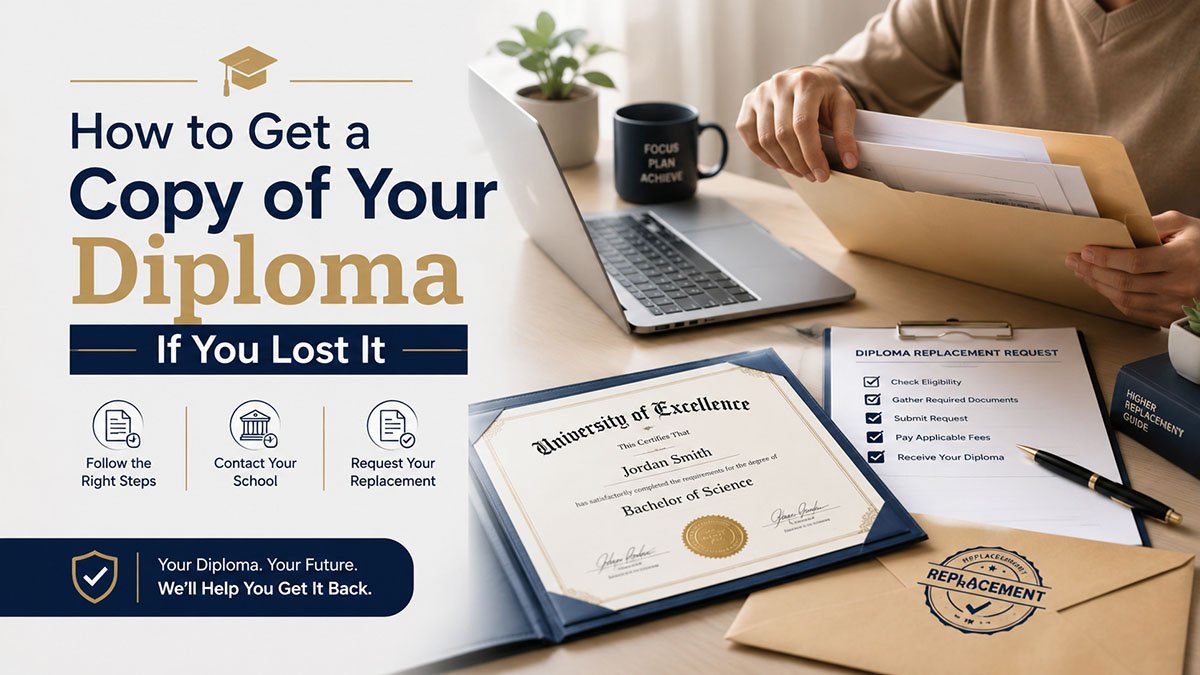
If you’ve lost your diploma, your first step is to contact your school’s registrar (or the institution that holds your records). For high schools, that’s the school or your local school district. For colleges and universities, most use the National Student Clearinghouse for replacement diplomas and transcripts. If your school has closed, the records have almost always been transferred to the state Department of Education or another designated custodian — they can issue a replacement transcript, a letter of completion, or in some cases a reprinted diploma. Expect a fee (usually $20–$100) and a wait of one to several weeks. If you also want something to actually frame and display, a custom display copy is the safe, legal way to do that — but it is never a substitute for the official document.
This guide walks through every realistic path to replacing your diploma in 2026 — high school, college, GED, closed schools, international degrees — and explains exactly when each one applies. Written based on the questions we hear every week from people in this exact situation.
Table of Contents
ToggleBefore You Start: What Are You Actually Trying to Replace?
The word “diploma” gets used loosely. Before you spend hours requesting the wrong thing, get clear on what you actually need:
| What you need | What it is | Where to get it |
|---|---|---|
| Official diploma | The physical certificate from your school | Your school’s registrar / records office |
| Official transcript | Itemized record of your courses & GPA | Registrar, or National Student Clearinghouse for most US colleges |
| Letter of completion / verification | Official letter confirming you graduated | Registrar, or state records custodian if school closed |
| Display copy | Custom-designed commemorative version | A design studio like THEGRADORA, not a school |
Here’s the part most people miss: for jobs, licensing, and admissions, employers usually want a verified transcript — not the framed diploma itself. If your goal is to satisfy a background check or HR request, requesting a transcript is often faster, cheaper, and more directly useful than chasing a replacement diploma. We’ve had customers spend weeks trying to get a replacement diploma when a transcript would have closed their employment verification in 24 hours.
If your goal is to hang something on your wall because the original is gone or damaged, you’re in a different lane — that’s where a display copy comes in (more on that below).
How to Replace a High School Diploma (US)
Step 1: Contact the school or district directly
If the school still exists, this is always your first call. Most US high schools and school districts have a records or registrar’s office that handles diploma replacement requests. Search the school’s official website for terms like “records request,” “diploma replacement,” or “transcripts.”
You’ll typically need to provide:
- Your full legal name at the time of graduation (including maiden name if applicable)
- Your date of birth
- The year you graduated
- A government-issued photo ID
- Sometimes your student ID number, if you remember it
- A fee, usually $15–$50
Processing times vary widely — anywhere from a few days to several weeks. If you need it for a job or licensing deadline, ask up front whether expedited processing is available.
Step 2: If you can’t reach the school, contact the district
If the school has consolidated, renamed, or moved, the school district that the school belonged to is the next stop. They typically maintain or know where to find records for all schools they oversee, including closed ones.
You can find your district through the National Center for Education Statistics (NCES) school search — a free .gov resource that lets you look up any US public school or district.
Step 3: If the school and district are gone, contact the state
If the entire district has dissolved (this happens more often than people realize, especially with older rural schools), records are usually transferred to the state Department of Education or a designated records custodian.
Search “[your state] department of education closed school records” or “[your state] high school diploma replacement.” Every US state has a process for this — it may just take a few phone calls to find the right office.
How to Replace a GED or High School Equivalency
GEDs and high school equivalency diplomas have their own paths:
- GED: Order through the official GED Testing Service at GED.com. They issue duplicate diplomas and official transcripts, typically processed in 1–7 business days.
- HiSET / TASC: These state-administered equivalency tests are replaced through the state’s Department of Education or the testing service’s official site.
Be cautious of look-alike sites that charge inflated fees for what’s a routine official request. Always start at the official testing service site, not the first Google ad.
How to Replace a College or University Diploma (US)
College replacement diplomas are usually a more involved process than high school ones, but the path is well-established.
Option 1: Contact your university registrar directly
Every accredited US college and university has a registrar’s office that handles diploma replacement. Most have a dedicated page — search “[your school name] replacement diploma” or look under the registrar’s site.
You’ll typically need:
- Your full legal name at the time of graduation
- Date of birth and approximate years of attendance
- Degree and major
- A government-issued ID
- A fee, usually $40–$100 (varies widely)
- Some schools require notarized requests or in-person pickup for security
Replacement diplomas from universities often take 4–8 weeks because they’re printed in batches with the same vendor that produces new graduates’ diplomas. Plan ahead — if you need something for a deadline, this is rarely fast.
Option 2: Use the National Student Clearinghouse for transcripts
For transcripts (which, again, is often what employers actually want), the fastest route for most US colleges is the National Student Clearinghouse. It’s the nonprofit organization founded by the higher education community in 1993 and used by nearly every US college and university.
You can order an official transcript online, and many institutions deliver electronically within 24–72 hours. This is the same system most graduate schools and employers expect.
Note that the Clearinghouse generally handles transcripts, not physical replacement diplomas — for the diploma itself, you still need the registrar.
Option 3: Contact your school’s alumni office
For older graduates whose records may be archived, the alumni or development office is sometimes a faster route than the registrar. They often have contacts on the records side and can help expedite or troubleshoot.
What If Your School Is Closed?
This is one of the most common situations we hear about — and it’s more solvable than people expect.
Your records still exist. When an accredited US school closes, federal and state law generally require that academic records be transferred to a custodian — usually the state Department of Education, the state’s higher education commission, or a designated records repository. You have a legal right to verification of your completion even if the school itself is gone.
The process:
- Find the records custodian. Search “[your state] closed school records” on your state Department of Education website. Most states have a dedicated office for this.
- Submit a records request. You’ll usually need your name, dates of attendance, the school name, and ID. Fees vary but are typically modest.
- Request what’s available. The custodian can usually issue: an official transcript, a letter of completion, and sometimes a replacement diploma (depending on the state).
For employment or licensing, a transcript or letter of completion from the state custodian carries the same legal weight as a diploma from the original school. It is the official record.
This is also where many customers find us. Sometimes the state can issue a transcript but not a reprinted diploma — leaving the person with proof for legal purposes, but nothing to frame or display. That’s a legitimate situation for a display copy (we’ll get to that).
What If Your Diploma Is from Outside the US?
International degree replacement varies enormously by country, but the basic pattern is the same: start with the institution, escalate to the ministry of education if the institution is unreachable.
A few US-specific considerations if you’re now in the States:
- For employment or immigration use, you may also need a credential evaluation from a service like WES (World Education Services) or other NACES-member evaluators, which translate foreign credentials into US equivalents.
- If the institution is in a country you can’t easily contact (closed, political instability, lost records), the credential evaluation services can sometimes work with what documentation you do have.
For purely display purposes (a custom keepsake to hang at home), an international graduate can order a display copy regardless of where the original was issued.
When a Display Copy Makes Sense
A display copy is a custom-designed commemorative version of a diploma — created for framing, gifting, and personal use, not as an official document. It comes from a design studio, not a school. It does not replace, substitute for, or in any way stand in for an official diploma.
A display copy is the right choice when:
- You want to frame your achievement on a wall without risking the only original copy you have (or once had).
- Your original was destroyed (fire, flood, age) and you’ve already requested an official replacement for verification purposes — but you also want something on the wall now.
- Your school closed and the state custodian could provide a transcript but not a reprinted diploma — and you want a personalized commemorative piece.
- You completed a program (homeschool, private course, milestone) that didn’t issue a traditional diploma.
- You want to give a personalized keepsake as a gift — for a graduating family member, partner, or friend.
A display copy is not the right choice when:
- You need to prove your degree to an employer, school, licensing board, or government agency. Always go through the official channels above.
- You want a document that will be accepted for verification. It won’t be, and using it for that purpose is fraud.
For a full side-by-side breakdown, see our Display Copy vs Official Diploma guide. For materials and sizing, see getting a display copy of a diploma or transcript.
What to Do While You Wait
Official replacements often take weeks. In the meantime:
- Request a transcript first. It’s usually faster and is what most employers actually need.
- Save digital copies of everything. If your school sends you a PDF version, store it securely — in a password manager or encrypted cloud folder.
- Keep records of your request. Confirmation numbers, dates, names of who you spoke with. This saves you when you have to follow up.
- If you need something on the wall now, a display copy can fill that role — for display purposes only, while the official process plays out.
How to Avoid Scams
This is a topic with a lot of bad actors, and you should know the red flags:
- “Buy a real diploma instantly” or “life experience degree” — these are diploma mills. Avoid them. They produce documents that are worthless and can get you in serious trouble if used for employment or admissions.
- Sites that promise to issue “authentic” or “verifiable” diplomas from a school you didn’t attend. This is fraud, full stop.
- Anything that won’t clearly tell you the document is for novelty/display use only. Legitimate display copy providers (us included) state this prominently and never imply otherwise.
- Pressure to pay with untraceable methods (wire transfer, cryptocurrency only) and no clear refund policy.
When in doubt, the official school/state route is always safer than an unfamiliar third party — even if it’s slower.
Frequently Asked Questions
How long does it take to get a replacement diploma? For high schools, typically 1–4 weeks. For colleges, often 4–8 weeks because they’re printed in batches. Transcripts are usually faster — sometimes 24–72 hours through the National Student Clearinghouse. Closed school requests can take longer, depending on where the records are archived.
How much does a replacement diploma cost? High schools usually charge $15–$50. Colleges typically charge $40–$100 or more, especially for notarized or expedited versions. Transcripts are usually $10–$30 per copy.
Can I get a replacement diploma online? Yes — most US schools and the National Student Clearinghouse accept online requests. You’ll usually upload ID and pay online; the document is mailed (or, for transcripts, often emailed).
What if my school refuses or doesn’t respond? Try the school district (for K-12) or the state Department of Education. Every state has a process for diploma and transcript requests, and they’re legally required to maintain access to academic records.
Do I need the original diploma for a job or background check? Usually not. Most employers and background check companies verify education through transcripts or direct school verification — not the framed diploma. If an employer specifically asks for a copy of your diploma, contact your school for an official replacement, not a third-party service.
Can I use a display copy if I can’t get the official one? For display purposes only — yes. To hang on a wall, commemorate the achievement, or give as a gift, a display copy is exactly what it’s designed for. For employment, licensing, admissions, or any official verification, no — you must continue working with your school or state records custodian. A display copy and an official diploma serve completely different purposes.
My diploma was destroyed in a fire/flood/disaster. What now? Contact your school’s registrar and explain the situation. Many schools have specific processes for disaster-related replacements and may waive fees or expedite the request. The state Department of Education can also help if records were affected on the school’s end.
Is a display copy the same as a fake diploma? No. A display copy is a clearly-labeled commemorative design for display and personal use only. A fake diploma is something passed off as an official document to deceive — that’s fraud. Reputable display copy providers (us included) state the novelty/display-only purpose clearly and never imply otherwise.
Need a Display Copy While You Wait — or Instead of Framing the Original?
If you’ve gone through the official process and still want something to actually frame, gift, or display — that’s exactly what we make. THEGRADORA creates custom display copies designed for the wall, the shelf, or the gift box. They are not, and never will be, a substitute for the official document — but for showing your achievement, they’re built for it. If you already have the official records you need and only want something commemorative to display, you can create a personalized degree design online for your wall, shelf, or gift presentation.
Browse our shop, start a custom order, or learn more in our complete guide to custom keepsakes.
THEGRADORA products are custom keepsakes intended solely for novelty, display, commemorative, and personal use. They are not official academic records and must not be used for employment verification, academic admission, professional licensing, identity verification, or any misleading purpose. For an official replacement diploma, always contact your school’s registrar or your state’s Department of Education.