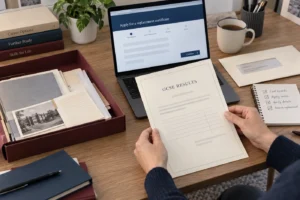

A replacement degree certificate commonly takes several weeks rather than several days. For planning purposes, allowing roughly three to six weeks for the university’s checks and production, followed by delivery time, is more realistic than expecting an instant copy. That is only a planning range, though. Your university’s current service page is the authority: some institutions publish a shorter target, some warn that the process may take longer, and older or complicated records can sit outside the normal timeframe.
What should you allow? Start with the university’s published processing period, count it in working days if that is how it is stated, and then add postage or courier time. Add a further safety margin if you graduated many years ago, changed your name, studied through a partner college, live overseas or need the certificate for legalisation. If a deadline falls inside that window, ask for interim proof of the award now rather than waiting for the paper certificate to arrive.
The phrase “replacement degree certificate processing time” can be misleading because several clocks are involved. The university may first check your identity and eligibility, locate the academic record, approve the request, produce the new document and dispatch it. The postal service or courier then has its own delivery period. A page that says “up to 20 working days” may refer only to the university’s part, not the date on which an overseas applicant will hold the certificate.
This article is about those clocks: when they start, what usually slows them down, how to estimate a sensible arrival date and what to do if you need proof sooner. If you have not yet applied, our step-by-step guide explains how to get a replacement degree certificate in the UK. If you have only just discovered the loss, first confirm what evidence the recipient needs before ordering a paper document.
There Is No Single Replacement Degree Certificate Timeframe
Universities do not share one national production office or one standard service level. Each institution controls its own student records, identity checks, payment system, approval rules and dispatch arrangements. That is why a friend’s experience at another university is not a reliable promise for your request.
Even two requests sent to the same university can move at different speeds. A recent graduate whose student number, current name and award details match the live records system may be straightforward. A person who graduated under a former surname in the 1980s through a college that later merged may require a manual archive search and extra evidence. Both are asking for the same type of document, but the work behind it is not the same.
Published estimates also use different language. Look carefully for phrases such as:
- “We aim to process” — a service target, not necessarily a guaranteed deadline;
- “Allow up to” — the request may be completed sooner, but you should plan around the full period;
- “Working days” — weekends and public holidays normally do not count;
- “After receipt of all documents” — the clock may not start when you first open or submit the form;
- “Dispatch within” — this usually ends when the university sends the certificate, not when it reaches you; and
- “Delivery estimate” — a postal or courier estimate that comes after institutional processing.
As one current example, the University of Oxford’s official degree certificate ordering page says online shop orders can on occasion take up to 21 working days to process. The same page then describes separate UK post and courier arrangements. Twenty-one working days is roughly four ordinary weeks before allowing for dispatch and delivery, and a public holiday can extend the calendar date further.
Useful rule: never turn a university’s processing target into a promised arrival date. Add the delivery estimate and a buffer, especially when an employer, regulator, embassy or overseas university has set a hard deadline.
Processing Time and Delivery Time Are Different
People naturally ask, “How long to replace a degree certificate?” as if the answer were a single number. In practice, the total is the sum of at least two periods:

University processing time runs while the institution checks the application, verifies the academic record, approves the issue, produces the certificate and prepares it for dispatch.
Delivery time begins after dispatch. It depends on the method selected, the destination, local postal conditions, customs handling and whether somebody must sign for the package.
There may also be a third period before processing begins. For example, the university might place the request on hold until it receives clear identification, a statutory declaration, proof of a name change, payment or the damaged original. If you send the application on Monday but provide the missing evidence two weeks later, the university may measure its service target from the later date.
This distinction matters most when you are choosing express delivery. Paying for a courier may shorten the journey after dispatch and provide tracking. It does not normally move your request ahead of identity checks, archive searches or production. “Express shipping” is not automatically “express replacement”. Before paying more, ask whether the fee affects processing, delivery or both.
When Does the Processing Clock Actually Start?
The safest assumption is that the clock starts only when the university has a complete, paid and usable request. A web form confirmation proves that information was submitted; it does not always prove that the records team has accepted it as complete.
A request is more likely to be ready for processing when the institution has:
- your full name at the time of study and your current name;
- date of birth and, where available, student or candidate number;
- the correct institution, course, award and graduation year;
- clear identification that meets the stated rules;
- evidence connecting former and current names if required;
- the loss or damage declaration requested by the university;
- payment through the correct channel;
- a deliverable postal address in the required format; and
- the damaged original, if the replacement policy requires its return.
Check the automatic acknowledgement. It may say that the order has been received, that it is awaiting review or that further evidence will be requested. Those phrases are not interchangeable. If there is an order number, save it. If payment is taken separately, keep that receipt too.
Spam filters create surprisingly ordinary delays. Add the records office address to your safe-senders list and check junk mail during the first week. If the team asks for a better scan and the message sits unread for ten days, the certificate has not been in active production during that time.
A Realistic Stage-by-Stage Timeline
The sequence below is not a promise from any particular university. It is a practical way to understand what may be happening between payment and delivery.
Stage 1: Submission and Initial Review
The institution records the request and checks whether it belongs in the correct service. Staff may confirm that the applicant is the graduate, that the award is eligible for replacement and that the necessary declaration or identification has been supplied. A request sent to alumni relations when certificates are handled by student records may first need to be redirected.
This is where obvious omissions are found. An unclear passport image, missing former surname, inconsistent date of birth or absent payment may pause the case. Responding promptly is one of the few parts of the timeframe you can directly control.
Stage 2: Locating and Checking the Academic Record
For a recent award, the record may be readily available in the institution’s current system. For an older award, staff may need to search a legacy database, scanned register, paper archive or records inherited from another institution. They may also have to establish which university held awarding powers when you studied.
This stage protects the integrity of the qualification. The university is not simply retyping words from a photograph you provide; it must issue the document from its own verified record. A scan of the lost certificate can help staff identify the award, but it does not replace their checks.
Stage 3: Approval and Production
Once the record is confirmed, the replacement may enter a production queue. Depending on the institution, certificates may be produced in batches, require authorised signatures, use controlled stationery or pass through a separate awards office. A request can therefore be approved without being printed and posted on the same day.
Some institutions may issue a secure electronic document or award letter sooner than the formal paper certificate. That is worth asking about if the recipient accepts it. It is also why “proof of degree” and “replacement certificate” should not be treated as identical services.
Stage 4: Dispatch
Dispatch means the document has left, or is ready to leave, the university. An untracked postal service may provide no further event. A courier service normally produces a tracking number, but the number can be created before the parcel is physically scanned into the carrier’s network. Allow a little time for the first update.
Stage 5: Delivery
UK delivery may take only a few days once dispatched, but that is not guaranteed. Overseas delivery can take substantially longer. Customs, local postal handover, incomplete address details, remote-area service and failed delivery attempts all add time. If the document is being sent to an agent, employer or legalisation provider, confirm that the named recipient and address are acceptable to the courier.
Why Older Degree Records Often Take Longer
Age alone does not make a record impossible to find. Universities retain award records, and many have digitised historical information. Still, a qualification from several decades ago is more likely to require manual work than one held in a current student-record system.

The course may have been taught at a college whose name has changed. The awarding university may have merged, the faculty may have closed, or administrative responsibility may have moved. Older records may use different course titles, abbreviations or student-number formats. Your exact name at the time becomes especially important.
You can reduce search time by providing specific, accurate context:
- the full name used while studying, including middle names;
- the name of the teaching college and the awarding university;
- campus or department;
- course title and qualification level;
- attendance dates and approximate award date;
- student, candidate or registration number;
- copies of a transcript, results letter or old certificate scan; and
- any former institutional name shown on your paperwork.
Do not guess grades, dates or award titles merely to fill every box. Mark an item as approximate when it is approximate. Confident but incorrect information can send an archive search in the wrong direction.
Common Reasons a Replacement Is Delayed

Incomplete or Unreadable Identification
A cropped driving licence, blurred passport page or expired document may not meet the institution’s rules. Read the upload instructions before taking the image. Show all required edges and details, use good light and avoid glare. Send sensitive information only through the official channel named by the university.
A Name Difference
Your current identification may not match the academic record because of marriage, divorce, adoption, gender transition or another legal change. The university may ask for supporting evidence. Some institutions print the name held at the time of award; others have a formal name-change policy. Do not assume a replacement request automatically updates the certificate.
The Wrong Institution Was Contacted
The college where you attended classes was not always the body that awarded the degree. That distinction is common in validated, franchised and partner provision. The teaching college may help identify the correct records holder, but the awarding institution normally controls the official certificate.
The Original Is Damaged Rather Than Lost
A university may require a damaged original to be returned before releasing a new one. Postal time to send it back then becomes part of the process. Use the requested method and retain proof of posting. Never destroy the original unless the university tells you to do so.
Peak Workloads and Closures
Graduation periods, examination boards, enrolment, Christmas closure and public holidays can reduce the working time available to records teams. An estimate stated in working days already excludes weekends; an institutional closure may add more calendar days. Submit early if your deadline falls around a busy academic period.
Overseas Address or Customs Problems
International delivery is vulnerable to address formatting errors, customs examination and carrier handovers. A courier can improve visibility, but it cannot remove every delay. Check whether the university permits delivery to a trusted UK address, legalisation provider or other nominated recipient if that route suits your next step.
A Renamed, Merged or Closed Institution
Records may have transferred to a successor university, archive or appointed custodian. Finding that body can take time before the replacement process even begins. Our broader replacement educational documents guide explains how to separate the current institution, the former name and the awarding body when tracing records.
How to Estimate Your Own Arrival Date
Begin with a calendar, not a hopeful guess. Find the university’s current published estimate on the exact service page you are using. Then work through these steps:
- Choose the real start date. Use the date on which payment and every required document were received, not necessarily the date you first asked a question.
- Convert working days properly. Five working days usually span one ordinary week. Twenty working days are roughly four ordinary weeks, before public holidays or closures.
- Add production or dispatch time if stated separately. Some pages describe record checks and printing in different terms.
- Add the carrier’s delivery estimate. Use the method actually selected, not the fastest option displayed on the page.
- Add a safety margin. The tighter and more important the deadline, the larger the margin should be.
- Add time for the next process. Translation, notarisation, an apostille, embassy handling or professional registration begins after the document arrives.
Suppose a university says processing can take 20 working days and you submit a complete request on Monday. That is about four ordinary weeks. If tracked delivery is estimated at two working days, do not promise a recipient that the certificate will arrive in exactly 22 working days. A query about identification, a bank holiday or a missed courier delivery could move the date. Treat the calculation as the earliest sensible planning window plus contingency, not a guarantee.
Before giving someone an expected date, confirm:
- the university has accepted the request as complete;
- the published period refers to processing, dispatch or delivery;
- you counted working days rather than calendar days;
- your selected postal method includes tracking if needed;
- the delivery address is complete and someone can receive it; and
- any translation or legalisation stage has its own time allowance.
What to Do If You Need Proof Urgently
A paper replacement may be the document you eventually want, but it is not always the only evidence an employer, university, regulator or professional body can accept. Contact the recipient first. Explain that an official replacement is being processed and ask what temporary or direct evidence is acceptable.

Depending on the awarding institution and the recipient, possible alternatives include:
- an official academic transcript;
- an award-confirmation or degree-confirmation letter;
- a secure digital academic document;
- verification sent directly by the university;
- a verification response through an authorised service; or
- a certified copy of an existing original, where the recipient expressly permits it.
In the UK, Hedd provides an official higher-education verification service used by employers and other organisations. Verification is not another degree certificate, and it will not satisfy every request for an original paper document. It can, however, answer the underlying question — whether the award is genuine — when the recipient uses that route.
Oxford offers another useful illustration of the distinction. Its certificate service points graduates who already hold a certificate but require proof towards a degree confirmation letter through its electronic documents service. The right answer in an urgent situation may therefore be “request a different official record now and let the replacement certificate follow”, not “find somebody else to reproduce the university document”.
Do not substitute an unofficial document for academic proof
A privately produced certificate cannot verify a degree, replace the university’s record or satisfy employment, admission, immigration, licensing or identity checks. If official proof is required, use the awarding institution or its authorised verification route. A convincing appearance does not make a document official.
Can You Pay to Get a Replacement Faster?
Sometimes there is a faster delivery option. Far fewer universities offer a paid fast-track for the institutional checks and production themselves. Read the wording carefully before paying.
A courier upgrade may provide quicker transport, tracking and proof of delivery. It does not usually shorten an archive search or move the document ahead of other approved requests. An “urgent” note in a comments box may alert staff to a deadline, but it does not create capacity or waive identity safeguards.
If a fast-track service exists, check what it promises and when its clock begins. It may exclude complex or historic records. It may also have a daily cut-off, require complete evidence at submission and cover dispatch rather than arrival. Keep the published terms with your receipt.
When no fast-track exists, the better strategy is to separate the two needs. Ask for the paper replacement through the normal route, then arrange accepted interim proof for the immediate deadline. This is often more realistic than repeatedly asking the certificate team to override its queue.
When Should You Follow Up With the University?
Following up too early rarely speeds production. It can add to the same team’s workload, and some service pages specifically ask applicants not to request progress reports inside the stated processing period. On the other hand, waiting indefinitely after the published period has passed is unnecessary.
A sensible follow-up point is usually:
- immediately, if payment failed or no submission confirmation appeared;
- promptly, if the university requested evidence and you have supplied it but received no acknowledgement;
- after the full published processing period has passed, if no dispatch update arrived;
- when tracking shows an exception, failed delivery or unexplained lack of movement; or
- before a hard deadline only to ask about interim proof, not to demand a guaranteed paper arrival date.
Use the channel named on the service page. A concise message is easier to action than a long account sent to several unrelated departments.
Do not attach identity documents to an ordinary follow-up email unless the institution’s instructions say that channel is secure and acceptable. Refer to the earlier upload or ask for the approved method.
What If the Certificate Was Dispatched but Has Not Arrived?
First, establish what “dispatched” means. Ask for the dispatch date, delivery method, destination address and tracking number if one exists. Check the address character by character, including postcode, flat number and country. A small omission can matter.
For tracked shipments, use the carrier’s official website rather than a link in an unexpected text message. If tracking shows a delivery attempt, rearrange delivery promptly. If it shows customs action, follow the carrier’s instructions and confirm whether duties or additional documents are required.
For untracked post, the university may ask you to wait a defined period before treating the item as lost. Ask about its non-delivery policy rather than immediately paying for another certificate. Some institutions will investigate or reissue only after that waiting period and may require confirmation of the address.
If the package arrives bent, wet or otherwise damaged, photograph the packaging and certificate before discarding anything. Contact the university and carrier promptly. The institution may require the damaged document to be returned, so keep it safe.
Overseas Use Needs More Time Than Overseas Delivery
Applicants often focus on how long the courier will take and forget what happens after delivery. A replacement certificate needed abroad may also require certification, notarisation, an apostille, consular handling or translation. Those are separate processes with their own rules and queues.
Before ordering, ask the final recipient exactly what it requires:
- the original replacement certificate or an institution-issued electronic record;
- a transcript as well as the certificate;
- verification sent directly by the university;
- a certified copy rather than the original;
- an apostille or another form of legalisation;
- a translation by an approved translator; and
- delivery in a sealed university envelope.
Ordering the wrong format can cost more time than ordinary processing. If an apostille is required, read our guide to preparing an academic document for apostille use, then confirm the current government and destination-country requirements. Do not send the replacement into another process until you know whether it must remain sealed or unaltered.
Can a Digital Document Arrive Faster?
It may, but availability and acceptance vary. A secure digital award document can avoid printing and international post, yet the university may still need to locate and verify the record first. Older cohorts may not automatically have digital records available.
Ask two separate questions:
- Can the university issue an official digital certificate, transcript or confirmation letter for my award?
- Will the organisation requesting proof accept that exact document and delivery method?
A PDF that you scan yourself is not the same as a secure digital credential sent or validated by the institution. The value comes from the issuing and verification system, not merely from the file format. Forwarding, screenshots and printing may also affect how the recipient can validate it, so follow the supplied instructions.
What If You Only Need Something for Personal Display?
Sometimes the urgent need is not academic verification at all. A graduate may want a framed item for a family gathering, photography, theatre, a private display or a commemorative presentation while an official replacement remains in the university’s queue.
A separate option for clearly non-official use
If your purpose is entirely personal and decorative, THEGRADORA offers a custom degree certificate tool and a catalogue of personalised degree certificates. These products are not issued by a university, do not verify an award and must never be used for employment, education admission, licensing, immigration, identity checks or any misleading purpose.
This route does not make the official process faster and should never be presented as a university replacement. Keep the two purposes separate: the awarding institution supplies academic evidence; a private display product is only for a clearly non-official setting.
Important Notice
THEGRADORA cannot access university records, confirm qualifications or issue official replacement degree certificates. Its products are personalised display items for personal, commemorative, photographic, theatrical or event use only. They are not issued or endorsed by a university and cannot be used as proof of education.
For employment, further study, professional registration, immigration, licensing, legalisation or any other verification purpose, obtain evidence from the awarding institution or its authorised records provider. Never alter, imitate or present a private product in a way that could mislead another person about its origin or status.
How to Avoid Losing More Time
A replacement request is largely administrative, but a few careful choices prevent avoidable delays:
- Use the current page on the university’s own website, not an old forum link or saved form.
- Confirm the awarding institution before paying.
- Give the name used during study as well as your current name.
- Upload clear identification in the accepted format.
- Explain whether the certificate is lost, stolen or damaged.
- Use an address that will remain valid throughout processing and delivery.
- Keep the submission confirmation, receipt and reference number together.
- Check email and junk mail for requests from the records team.
- Tell the eventual recipient early if the paper certificate may miss its deadline.
- Ask for interim official proof instead of ordering an unofficial substitute.
After the replacement arrives, scan it for your private records, note the certificate number if appropriate and store the paper away from moisture, direct sunlight and frequent handling. Do not post a full, readable image online. If the original later turns up, ask the university whether it became invalid when the replacement was issued and follow its instructions.
Frequently Asked Questions
How long does a replacement degree certificate take?
It often takes several weeks. A practical planning range is roughly three to six weeks for university processing plus delivery, but there is no universal timeframe. Use the current estimate published by your awarding institution and add extra time for older records, missing evidence, overseas delivery or legalisation.
Does the university’s processing time include delivery?
Usually not unless the page clearly says so. Processing normally covers checking, approval, production and dispatch. Postal or courier delivery begins afterwards, so add the carrier’s estimate and a safety margin.
When does the replacement certificate clock start?
It may start only after the university has received a complete application, acceptable identification, any required declaration and payment. If information is missing, the request can remain on hold even though the form was submitted earlier.
Can I get a replacement degree certificate urgently?
Some universities offer faster delivery, but that does not necessarily speed up record checks or production. Ask whether a fast-track exists and what it covers. If the paper certificate cannot arrive in time, ask the recipient whether it will accept a transcript, confirmation letter, secure digital document or direct university verification.
Does courier delivery make the whole process faster?
A courier can shorten or track the journey after dispatch. It normally does not shorten the university’s identity checks, archive search, approval or production queue. Confirm whether any fee relates to processing, delivery or both.
Why is my replacement degree certificate taking so long?
Common reasons include incomplete identification, a name mismatch, an older archived record, uncertainty about the awarding body, a requirement to return the damaged original, peak university workloads and overseas delivery issues. Check your email for requests and compare the elapsed time with the university’s published service period.
When should I chase a replacement degree certificate?
Follow up after the full published processing period has passed, unless payment failed, the university asked for further evidence or delivery tracking already shows a problem. Include the order reference, submission date, name used while studying, award and year.
Can I prove my degree while waiting for the replacement?
Often, yes. The recipient may accept an official transcript, award-confirmation letter, secure digital credential or direct verification from the university. Ask what it accepts and obtain the evidence through the awarding institution or its authorised provider.
Do old degree certificates take longer to replace?
They can. Older records may require a manual archive search or investigation of former institution names and awarding arrangements. Supplying your name at the time, course, dates, teaching college, awarding university and student number can help.
How long does overseas delivery take?
It depends on the destination, carrier, customs and address. Add the university’s full processing period before the delivery estimate. If the document also needs translation, notarisation or legalisation, allow separate time for those steps.
Is a digital certificate faster than a paper replacement?
It may avoid printing and post, but the institution may still need to verify the record. Digital documents are not available for every award, and the recipient must agree to accept the exact document and verification method offered.
Can THEGRADORA issue an urgent replacement degree certificate?
No. Only the awarding institution or its authorised provider can issue official academic evidence. THEGRADORA can provide personalised items solely for clearly non-official personal display, but they cannot verify a degree or replace a university-issued certificate.
Plan Around the Full Journey, Not Just the Print Queue
The most useful answer to “How long does a replacement degree certificate take?” is not a single number. It is a calculation: complete application, university processing, production, dispatch, delivery and any later use such as translation or legalisation.
Check the awarding institution’s current service page, submit accurate evidence once, save every reference and count working days properly. If the deadline is close, speak to the recipient and arrange acceptable interim proof. That approach is usually faster, safer and more credible than waiting for the paper certificate without a backup plan.