
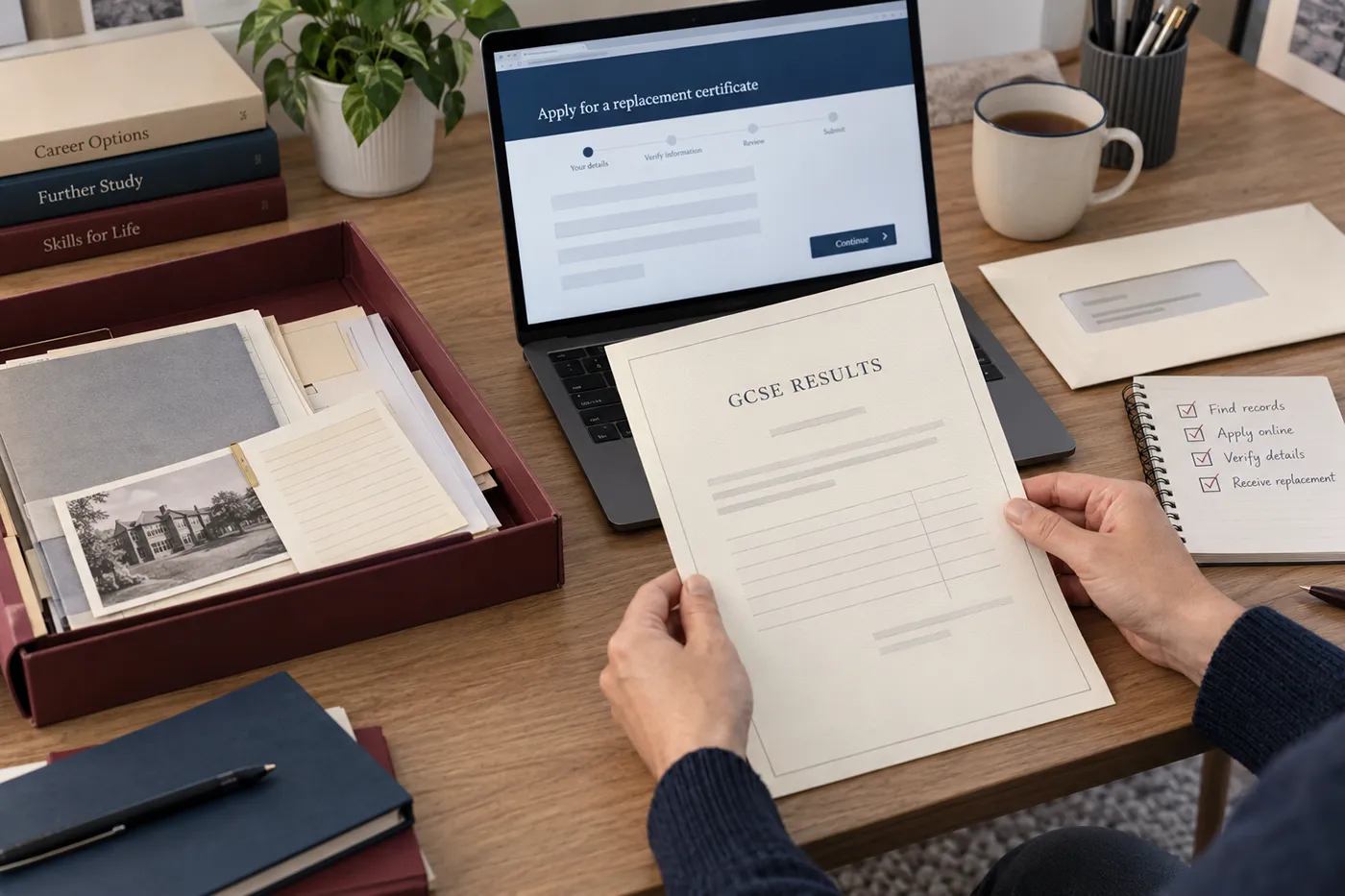
If you have lost your GCSE certificates, you normally cannot order an identical copy of the original certificate. Instead, the exam board that awarded your qualification can search its records and issue an official certified statement of results, sometimes called a certifying statement of results. It records the subjects and grades the board can confirm and can generally be used as formal evidence of your results.
Start by identifying which exam board handled each subject. Your former school or examination centre is usually the best first contact if you do not know. Once you have the board name, apply through that board's official certificate service, provide identification and as much examination information as possible, pay the current fee, and wait for the record search and document to be completed.
That sounds fairly simple, but old school names, several exam boards, missing candidate numbers and long-forgotten examination years can make the job feel surprisingly complicated. The process is much easier when you know what document to request and which details help the board find you. This guide explains how to get replacement GCSE certificates through the proper UK channels, including AQA, Pearson Edexcel, OCR and other awarding bodies.
If you are also dealing with a lost diploma, transcript or another academic record, our replacement educational documents guide explains how the issuing organisation changes the route you need to follow.
Can You Get a Replacement GCSE Certificate?
You normally cannot receive an identical replacement GCSE certificate. GOV.UK states that replacement certificates are not available for GCSEs, O levels, CSEs or A levels. For those qualifications, the relevant exam board provides a certified statement of results instead.
That wording matters. People often search for a “GCSE certificate replacement” because that is the practical outcome they need, but the document they order may not be titled “replacement certificate”. A certified statement is not a decorative copy or a printout of an online result. It is an official document produced after the awarding body searches and confirms its records.
According to the GOV.UK replacement exam certificate guidance, the statement can be used in place of the lost certificate, including for purposes such as a university application. The organisation requesting evidence may have its own submission rules, so ask whether it wants the statement sent to you or directly from the exam board.
Why is the new document not identical?
Certificate designs, security features, logos, board names and printing systems change over time. An exam board can confirm the result held in its records, but it may not reproduce the historical paper, artwork and exact appearance used in the year you sat the examination. Issuing a current official statement protects the integrity of the record without pretending that a newly printed document is the original.
Is a certified statement accepted?
It is the official replacement evidence provided for lost GCSE certificates. Pearson, for example, explains that its Certifying Statement of Results is an official document and includes an authenticity hologram. AQA can provide a certified statement to the candidate or, when requested, a confirmation letter sent directly to a third party. OCR also operates an official application service for lost certificates and statements.
Acceptance is ultimately decided by the employer, university, college, regulator or other recipient. If the evidence is needed for a deadline, ask the recipient exactly what it accepts before ordering. Some organisations prefer a document sent directly by the awarding body. Others may accept the original official statement supplied to you. A photograph, scan or screenshot may not satisfy their checks even when it is clear and genuine.
What Does a GCSE Certificate Look Like?
A GCSE certificate is an official document issued by an awarding organisation after a student completes one or more GCSE qualifications. Its exact appearance depends on the exam board, qualification, year of issue and country in which the qualification was regulated.
Most GCSE certificates typically display:
- The awarding organisation's name and logo
- The student's full name
- The school or examination centre
- The qualification title
- The subjects completed
- The grades awarded
- The date or examination series
- Relevant regulatory information
Certificate designs have changed over time, so an older certificate may look different from a recently issued one. A results slip, provisional statement of results or certified statement of results may also have a different appearance from the original GCSE certificate.
What Does an AQA GCSE Certificate Look Like?
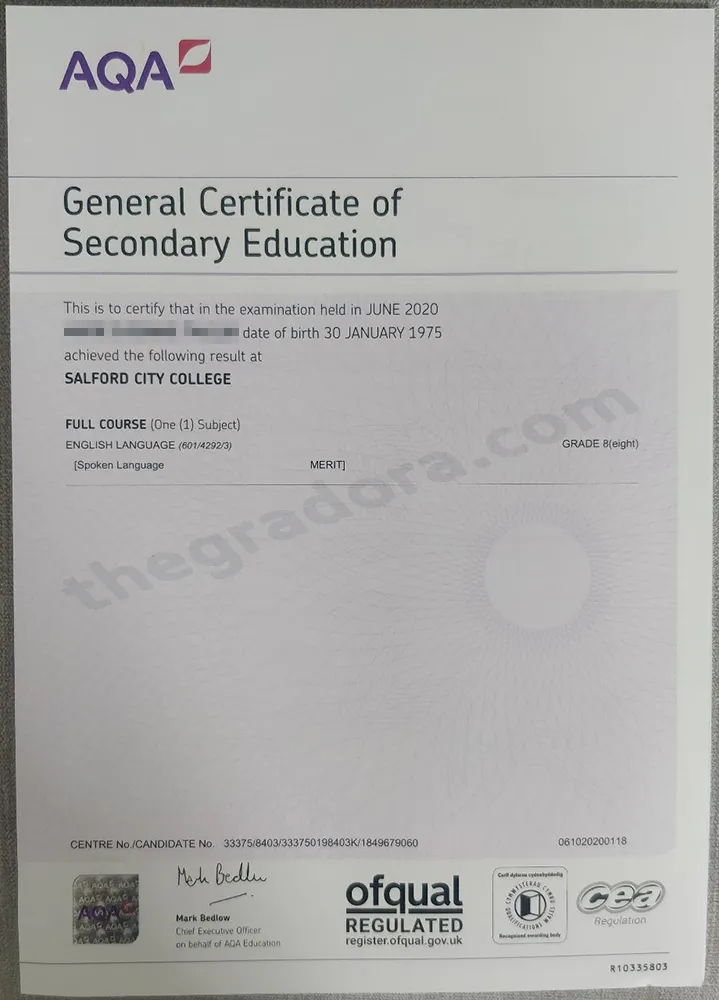
An AQA GCSE certificate normally carries prominent AQA branding and lists the candidate's qualifications and grades. It may also display relevant regulatory logos, depending on where the qualification was awarded and regulated.
If an original AQA certificate has been lost or damaged, AQA generally provides a certified statement of results after locating the candidate's records. This replacement document will not necessarily look identical to the original certificate.
What Does a Pearson Edexcel GCSE Certificate Look Like?
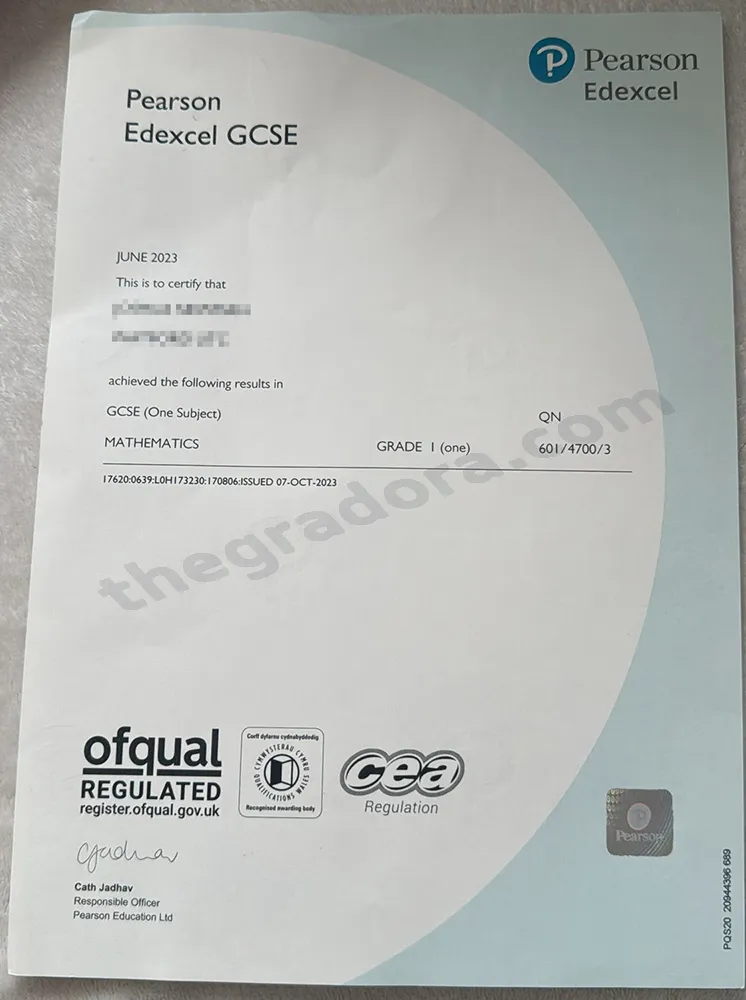
A Pearson Edexcel GCSE certificate displays Pearson Edexcel branding together with the student's name, qualification details, subjects and grades. The layout and branding may differ depending on the year in which the certificate was issued.
For GCSE and International GCSE qualifications, Pearson normally provides a Certifying Statement of Results when the original certificate has been lost. Pearson explains that this is an official document, although it may not look exactly like the original certificate.
What Does an OCR GCSE Certificate Look Like?
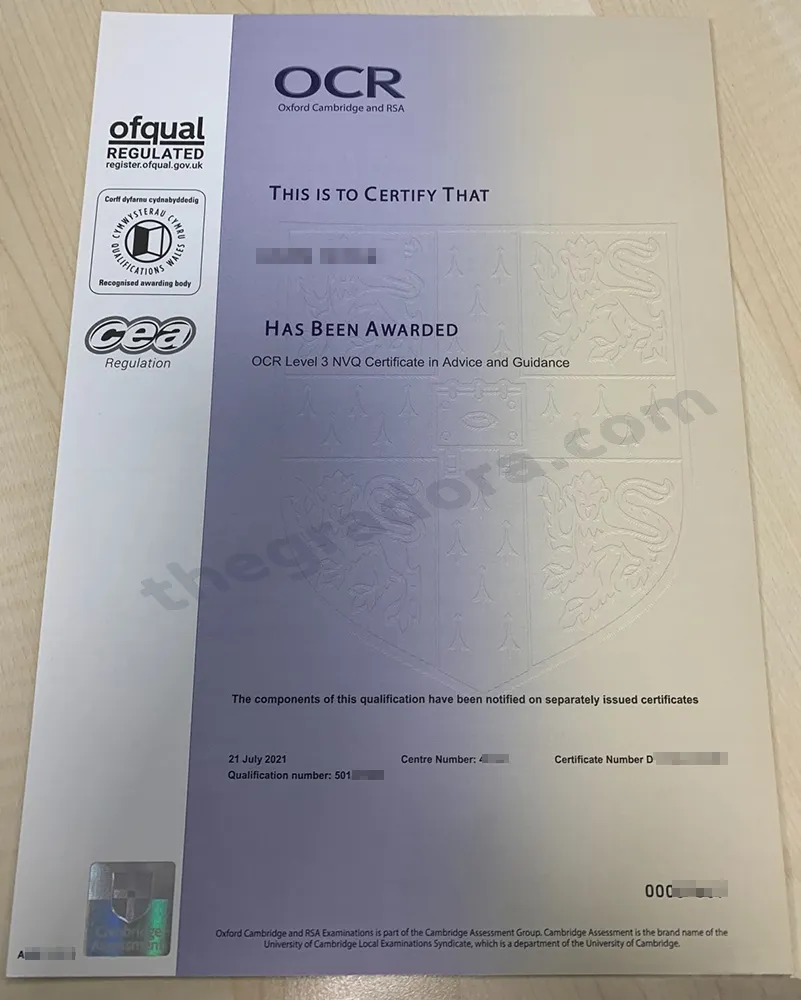
An OCR GCSE certificate includes OCR branding and normally shows the student's name, qualification title, subjects, grades and award details. Certificates issued in different years may use different layouts or branding.
OCR offers certificate services for people who have lost their original documents. Depending on the qualification and circumstances, the resulting document may be a replacement document or a certifying statement rather than an exact reproduction of the original certificate.
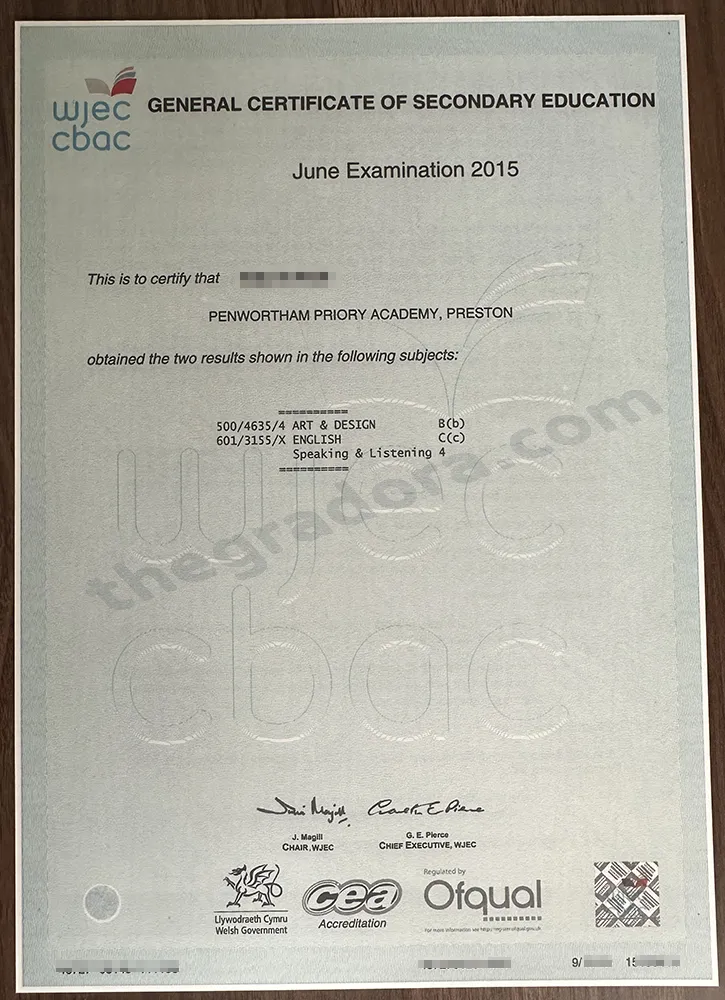
What Does a WJEC or Eduqas GCSE Certificate Look Like?
WJEC and Eduqas certificates may carry different branding depending on whether the qualification was offered in Wales or England. A certificate normally includes the awarding body's name, the student's details, the qualification or subjects completed, the grades and the award date.
Students who have lost a WJEC or Eduqas certificate should use the awarding body's official replacement certificate or proof-of-results service.
Is a Certified Statement of Results the Same as the Original Certificate?
No. A certified statement of results is an official record of the qualifications and grades held by the exam board, but it may not use the same layout, paper or design as the original certificate.
According to the UK government, exam boards generally do not issue identical replacement certificates for lost GCSE certificates. Instead, they provide a certified statement of results, which can normally be used as official evidence of the qualifications achieved.
A certified statement should not be confused with:
- A results-day slip
- A provisional statement of results
- A photocopy or scan of the original certificate
- A commemorative or display-only certificate
- A document created by an unofficial third party
How to Get Proof of Your GCSE Results
The most reliable process has six parts. You may finish in a few minutes if you still know the board and examination year, or you may need some preliminary research if the exams were taken decades ago.
1. Confirm which exam board awarded each result
Look at any surviving certificate, results slip, school report, college application, CV record or email that may name the board. Ask your former school or examination centre which boards it used in the relevant year. Remember to check subject by subject rather than assuming all GCSEs came from one board.
2. Check whether the board still exists
Many historical awarding bodies merged into today's boards. If the name you remember no longer operates, use the GOV.UK old exam board lookup to find the organisation that now holds its records. Do not send the same paid application to several boards until you have checked the predecessor list.
3. Open the correct official application service
Use the awarding body's own website. Search results can include document-design services, unofficial record searches and general advice pages that cannot issue academic proof. An official application should explain what records the board holds, what document it will provide, what identification it accepts, how fees work and where the statement can be delivered.
4. Gather identification and examination details
Prepare your full name at the time of the exams, date of birth, school or centre, examination year and month, subjects and grades if known, current contact details and proof of identity. If your name has changed, prepare evidence connecting the old and current names. Requirements vary, so follow the selected board's current checklist rather than uploading extra personal documents without being asked.
5. Submit the application and pay the current fee
Enter the details carefully. A wrong year, incomplete school name or missing former surname can slow the search or lead to no record being found. Fees are set by each board and can change. Review its refund terms before paying, especially if you are uncertain that the board holds your results.
6. Track the application and receive the official evidence
Save the application confirmation and reference number. Check your email, including spam or junk folders, in case the board needs clarification. When the document arrives, check the name, examination series, subjects and grades. Contact the board promptly if something does not match your application or the results you expected.
Find Out Which Exam Board You Used
Not knowing the board is the most common obstacle. It is also normal. Most pupils remember the school and subjects, not the awarding organisations printed on specifications and exam papers.
Ask your former school or examination centre
Contact the exams office, records office or main administration team. Give them enough information to distinguish you from other former pupils:
- your full name at the time;
- any previous surname;
- your date of birth;
- the year you left or the year you sat GCSEs;
- the subjects you took; and
- your candidate number, if you still have it.
The school may be able to identify the board from archived exam entries even if it no longer holds the certificate itself. Be prepared for the answer to differ by subject. Asking “Which board did you use for Year 11 in 2008?” is less precise than asking which board awarded your English, maths and science results in the summer 2008 series.
Use the examination year as a clue, not proof
Board names and school choices changed over time. A school using AQA for mathematics now may have used Edexcel in the year you attended. Likewise, remembering the logo on one certificate does not prove that the same board awarded every subject. The year helps the school or board search, but it should not be used to guess a board without another source.
Check the old exam board list
The government lookup maps many former boards to the organisations now responsible for their records. For example, several regional boards are now handled by AQA; Pearson Edexcel holds records from a number of former London and vocational examining bodies; and OCR holds records for former Oxford, Cambridge, RSA and regional boards. Some historical records are split, so follow the specific note for the old board rather than relying on a general family resemblance in the name.
If the school has closed
A closed school cannot issue a GCSE result, but local archives, the local authority, an academy trust or a successor school may help you identify the examination centre and boards used. Once the board is known, the application still goes to the awarding organisation that holds the result. GOV.UK's predecessor-board list is especially useful when both the school and the board name have changed.
Apply Through the Correct Exam Board
Each board has its own terminology, application form and record coverage. Read the service page before paying, even if you have previously ordered evidence from another board.
AQA certificate services
AQA's Past Results and Lost Certificates service allows a candidate to apply online for confirmation of historical results. If AQA finds the record, it can send a certified statement of results to the candidate. It can also send a confirmation letter directly to a third party such as an employer or university when requested.
AQA says it can only confirm exams taken with AQA or one of the predecessor boards whose records it holds. It also warns that it cannot confirm before a paid application whether it will find a particular record. This is why checking the board first is worth the effort.
For identity, AQA currently lists a birth certificate, current driving licence, current passport or identity card as examples. When the candidate's name has changed, it asks for supporting evidence such as a marriage certificate, deed poll, or relevant combination of decree absolute and birth certificate. Only the candidate can apply for their past results.
AQA currently provides hard-copy past-result documents rather than emailed digital copies and states that it does not offer fast-track handling. Treat those details as changeable service information and check the live application page before submitting.
Pearson Edexcel replacement documents
Pearson's Replacement Documents service explains which official document it provides for each qualification. For GCSE, Edexcel Certificate and International GCSE results, Pearson normally issues a Certifying Statement of Results, often abbreviated to CSoR.
Pearson says the CSoR is printed on certificate paper and carries a hologram. It may not look exactly like the original or use the same historical certificate paper, but it contains similar result information, including the subjects and grades Pearson can confirm. Pearson does not currently offer PDF versions of these replacement documents.
Do not select a vocational replacement-certificate option simply because it sounds closer to the phrase you searched. Pearson distinguishes general qualifications, including GCSE and International GCSE, from BTEC and other vocational qualifications. The document issued depends on the qualification and date.
If your request covers different qualification families, read Pearson's application instructions carefully. Its certificate service states that only one qualification can be processed per application, so a GCSE request combined with a separate BTEC request may require separate applications.
OCR lost certificates
OCR directs former candidates to its Replacement Certificates service and online CertStat application. For general qualifications such as GCSEs, OCR issues a certifying statement showing the passing grades it holds for the relevant examination series.
An “examination series” means a set of exams taken in the same period, such as a summer or winter sitting. OCR explains that, for general qualifications, the statement must show all passing grades obtained with OCR in that series rather than allowing the applicant to select only one preferred subject. That can be important if an employer asks for maths and English but the same OCR series also contains other results.
OCR's current identification guidance asks for a document showing the applicant's current name and date of birth, with further proof when the name has changed. Its application also asks for the school or college name and full address and the examination month and year. Check the live form for accepted file types before uploading documents.
WJEC and CCEA
If you studied in Wales, your GCSE certificate may have been awarded by WJEC. Its Replacement Exam Certificates and Proof of Results page explains the available confirmation services. WJEC currently offers an electronic letter of confirmation and a physical certifying statement option, with different fees and delivery expectations. Check what the organisation requesting your results will accept before choosing.
For qualifications awarded in Northern Ireland, CCEA may hold the record. Use the CCEA contact reached through the GOV.UK replacement-certificate guide and confirm the current candidate application procedure directly. If an older Northern Ireland board appears on your paperwork, the government predecessor list identifies whether CCEA is now the responsible organisation.
Information and Documents You May Need
A board searches historical records using the information you provide. Give accurate details, but do not invent a candidate number or grade to fill a blank field. “Not known” is better than a confident but incorrect answer.
Full name used at the time
Use the name under which you were entered for the exam, including middle names if they appeared in the school's records. If your current name is different, enter both where the form allows and provide the board's required link between them.
Date of birth
This helps the board distinguish candidates with similar names. Make sure the date matches your identification and use the format requested by the form.
School or examination centre
Give the full name used at the time, town or address, and centre number if known. If the school has since changed its name or become an academy, include the former name first and note the new name separately.
Examination year and series
Provide the year and, when possible, the month or series. Most school candidates sat their main GCSE exams in a summer series, but resits may have been taken at another time. If you completed subjects across more than one year, list each series separately.
Subjects and grades
List what you remember, but mark uncertain details as estimates. Old and new GCSE grading systems differ, so reproduce the grade style you recall rather than converting it yourself. The board will report the result in its official record.
Proof of identity
Common examples include a passport, identity card, driving licence or birth certificate, but accepted documents and file formats differ. Upload only through the board's official service and make sure the image is clear, complete and within any size limit.
Current delivery address and recipient instructions
Check whether the statement should come to you or go directly to a university, employer or other organisation. If the recipient has supplied a reference number, department or admissions address, include it exactly as requested.
Evidence of a name change
A marriage certificate, deed poll or another document may be required to connect your current identity with the examination record. This does not necessarily mean the board will reissue the historical result in the new name. Name-amendment policies are separate from lost-document services, so read the relevant board guidance if changing the printed name is important.
How Much Does It Cost to Replace GCSE Certificates?
There is no single UK-wide price. Each exam board sets its own fee, defines what the fee covers and decides whether pricing is per examination series, qualification, document, search or delivery method. International postage, extra copies and direct delivery to third parties may affect the total.
Prices change, so this guide deliberately does not quote a fixed amount. Use the current fee page linked from the relevant board's official application. Before paying, check:
- whether the fee covers one series or more than one;
- whether separate qualification types need separate applications;
- whether postage is included;
- whether additional copies cost extra;
- whether a third-party confirmation letter is a separate service; and
- what refund applies if the board cannot find your record.
A cheap application to the wrong board is still wasted time. Confirming the awarding body before paying is usually the best way to control the cost.
How Long Does It Take?
Processing time varies by board, demand, the age of the record, the completeness of the application and the delivery destination. A request that includes the correct board, centre, year, former name and clear identification is easier to process than one asking the board to search a wide range of possible years.
Do not rely on a turnaround time quoted in an old forum post or blog. Read the board's current service page on the day you apply. Some boards do not offer fast tracking, and a courier cannot shorten the record-search stage before the document is produced.
Plan backwards from your deadline
If a university, employer or training provider has asked for proof, contact it immediately. Explain that the original GCSE certificate is lost and that you are applying for an official statement from the awarding body. Ask:
- which exact document it accepts;
- whether it will accept temporary evidence while the application is processed;
- whether confirmation must be sent directly by the board;
- whether an application receipt helps protect the deadline; and
- the final date by which official evidence must arrive.
Do not promise a delivery date before the board confirms it. If the deadline is very close, ask the receiving organisation about its contingency procedure rather than ordering from an unofficial service that cannot verify results.
What If You Don't Know Your Exam Board?
Start with your former school or examination centre. Ask its exams or records team to identify the boards used for your subjects in the year you sat them. Provide your name at the time, date of birth, leaving year and subject list.
If the school cannot help, use any surviving paperwork to narrow the search. A results slip, school report, college enrolment form or old email may contain a board name, specification code, centre number or candidate number. Then compare any former board name with the government's old-board lookup.
You may need more than one application. It is common for a school to use several boards, and a board can only confirm results in the records it holds. Do not assume that the board for English also handled mathematics and science.
If no source identifies the board, make a reasoned list based on confirmed information and contact the boards' certificate services before applying where they offer pre-application guidance. Be honest about uncertainty. AQA, for example, says it cannot confirm whether it holds a result before an application and payment, so read each board's policy before deciding how to proceed.
Can Your School Replace the Certificate?
Usually, no. The school taught you and entered you for the exams, but the exam board awarded the qualification and issued the certificate. The school generally cannot create a new official GCSE certificate or certified statement from its own records.
Your school can still be extremely useful. It may:
- hold an original certificate that was never collected;
- identify the exam boards used for each subject;
- confirm the examination centre name or number;
- help establish the correct examination year;
- locate a provisional results record; or
- tell you which successor school, trust or archive holds older information.
For a recent result, always ask the school first. OCR and WJEC both tell candidates who never received the original to contact their school or college, and centres are generally expected to retain unclaimed certificates for a limited period. Once that period has passed, or if the certificate was collected and later lost, the formal evidence normally comes from the exam board.
Special Situations That Can Change the Process
You took GCSEs with several boards
Apply to each relevant board. One Pearson statement will not contain AQA or OCR results. Group your subjects by board and series before starting so that you can see how many applications may be needed.
Your name has changed
Provide the historical name exactly and upload the evidence required by the board. Do not assume the result will automatically be printed under the current name. Lost-result confirmation and certificate amendment are related but separate services, and special rules may apply in particular circumstances.
You took International GCSEs
Identify the awarding body named on the qualification. Pearson includes International GCSE among the general qualifications for which it provides a CSoR. Cambridge International operates its own lost-certificate service. Do not send a Cambridge International request to OCR merely because both organisations have Cambridge in their history or branding.
You need only maths and English
Tell the recipient what you are ordering, but check the board's document rules. OCR says its statement for general qualifications must show all passing grades it holds for the series, not only selected subjects. Other boards may structure the result differently.
Your results are from many years ago
Provide as much precise historical information as possible. Older records may sit under a predecessor board, a former school name or a different examination structure. A board may need more time to retrieve them, and success cannot always be guaranteed.
You received GCSE results in England in 2026
The Department for Education announced the national rollout of the Education Record app for Year 11 pupils in England from summer 2026. It is intended to give students ongoing access to their results after leaving school. If you are part of that cohort, check the official app route before paying for another document.
Access to a digital result does not automatically settle what a particular employer, university or regulator will accept. Ask the recipient whether the digital record is sufficient or whether it requires an exam-board statement sent through a particular channel.
Common Mistakes to Avoid
Applying to only one board for every subject
Check the awarding body for each subject. Multiple certificates from several boards are normal and may require several applications.
Using your current name without the examination name
The search needs to connect you to the original candidate record. Include the old name and the required evidence of change.
Guessing the examination year
If you are unsure, work from your school leaving date and ask the school to confirm. Mention resits or subjects completed early because they may belong to another series.
Paying before checking the recipient's requirement
An employer may want direct board confirmation, while a university may accept the statement delivered to you. Knowing the required route can prevent duplicate orders.
Waiting until the deadline
Record searches, queries about identity and postal delivery take time. Start as soon as you know evidence will be needed and keep the recipient informed.
Checklist Before You Apply
- Confirm whether the original may still be held by your school.
- Identify the exam board for each subject.
- Use GOV.UK to trace any board that no longer exists.
- Confirm the examination year and series.
- Write the school or centre name used at the time.
- Prepare your historical and current names.
- Scan the exact identity document accepted by the board.
- Prepare name-change evidence if required.
- Ask the receiving organisation what form of proof it accepts.
- Check the current fee, delivery option and refund terms.
- Allow time for the search, production and delivery.
- Save the application confirmation and reference number.
Disclaimer
GCSE certificates produced by THEGRADORA are commemorative display keepsakes intended only for personal display, gifting, remembrance, photography, theatre, events and other clearly non-official uses. They are not issued by AQA, Pearson Edexcel, OCR, WJEC, CCEA, a school, university or any awarding body, and they must never be used for employment, education admission, licensing, identity checks, immigration, verification or any misleading purpose.
If you need proof of GCSE results, apply to the awarding body. Only that body can search and certify its records. If your need is entirely decorative and no official claim will be made, you can view THEGRADORA's custom certificate or learn about a personalised certificate. The official and decorative routes serve different purposes and should never be presented as interchangeable.
Official Pages to Bookmark
- GOV.UK: Get a replacement exam certificate
- GOV.UK: If your old exam board no longer exists
- AQA: Past results and lost certificates
- Pearson Edexcel: Replacement documents
- OCR: Replacement certificates
- WJEC: Replacement certificates and proof of results
Frequently Asked Questions
How do I order replacement GCSE certificates?
First identify the exam board for each subject. Then use that board's official certificate service, enter your name at the time of the exams, date of birth, school or centre, examination year and subjects, upload the required identification, and pay the current fee. For GCSEs, the document sent is normally a certified or certifying statement of results rather than an identical copy of the original certificate.
How much does it cost to replace GCSE certificates?
There is no single price because each exam board sets its own fees. The total may depend on the number of examination series, qualification types, copies and delivery destinations. Check AQA, Pearson Edexcel, OCR, WJEC or the relevant board's live application page before paying; published fees can change.
How quickly can I get proof of my GCSE results?
It depends on the exam board, age of the record, completeness of your application and delivery method. Use the board's current turnaround guidance rather than an old quoted timescale. If you have a deadline, tell the employer, university or college immediately and ask whether it accepts temporary evidence while the official search is completed.
What if my old exam board no longer exists?
Use the GOV.UK old exam board lookup to find which current awarding organisation holds the former board's records. The list maps predecessor organisations to AQA, Pearson Edexcel, OCR, WJEC or CCEA as appropriate. Apply to the board named for your historical awarding body.
Can I get an exact copy of my lost GCSE certificate?
Normally not. GOV.UK says an identical replacement is not issued for GCSEs. The exam board provides an official certified statement of results instead. It may look different from the original, but it is the formal evidence designed to replace the lost certificate.
What if I do not know which exam board I used?
Contact your former school's exams or records office and ask which boards were used for your subjects in the year you sat them. Give your historical name, date of birth and leaving year. If the board name is old, check it against the GOV.UK predecessor-board list.
Can my old school issue a new GCSE certificate?
Usually no. The school may still hold an uncollected original or help identify your boards and examination details, but the official certified statement normally comes from the awarding body that holds the result.
Can I request only one GCSE subject?
That depends on the board's document rules. OCR says a statement for general qualifications must show all passing grades it holds for the relevant series. Tell the recipient which result it needs, but expect the official statement to reflect the board's full record for that sitting.
What if my name has changed since I took my GCSEs?
Apply using the name recorded at the time and provide the board's required evidence connecting it with your current name, such as a marriage certificate or deed poll. Check separately whether the board will print the historical or current name because amendment policies vary.
Will an employer accept a certified statement of results?
It is the official replacement evidence provided by the exam board, but the employer decides its verification procedure. Ask whether the statement can be sent to you or must be sent directly by the board. Do not assume that a scan, screenshot or ordinary photocopy will be accepted.
Getting Your GCSE Evidence Without Wasting Time
The route is straightforward once the awarding body is known: identify every board, gather accurate candidate and examination details, apply through the official service, and give the board time to search and certify its record. The document may be called a certified statement or a certifying statement of results, but for GCSEs it is the legitimate answer to a lost original.
Begin with your school if the certificate was never collected or the board is unknown. Move to GOV.UK when an old board name no longer exists. Then follow AQA, Pearson Edexcel, OCR, WJEC or CCEA's current instructions rather than relying on an unofficial replacement service. That sequence gives you the best chance of obtaining evidence the recipient can actually verify.