
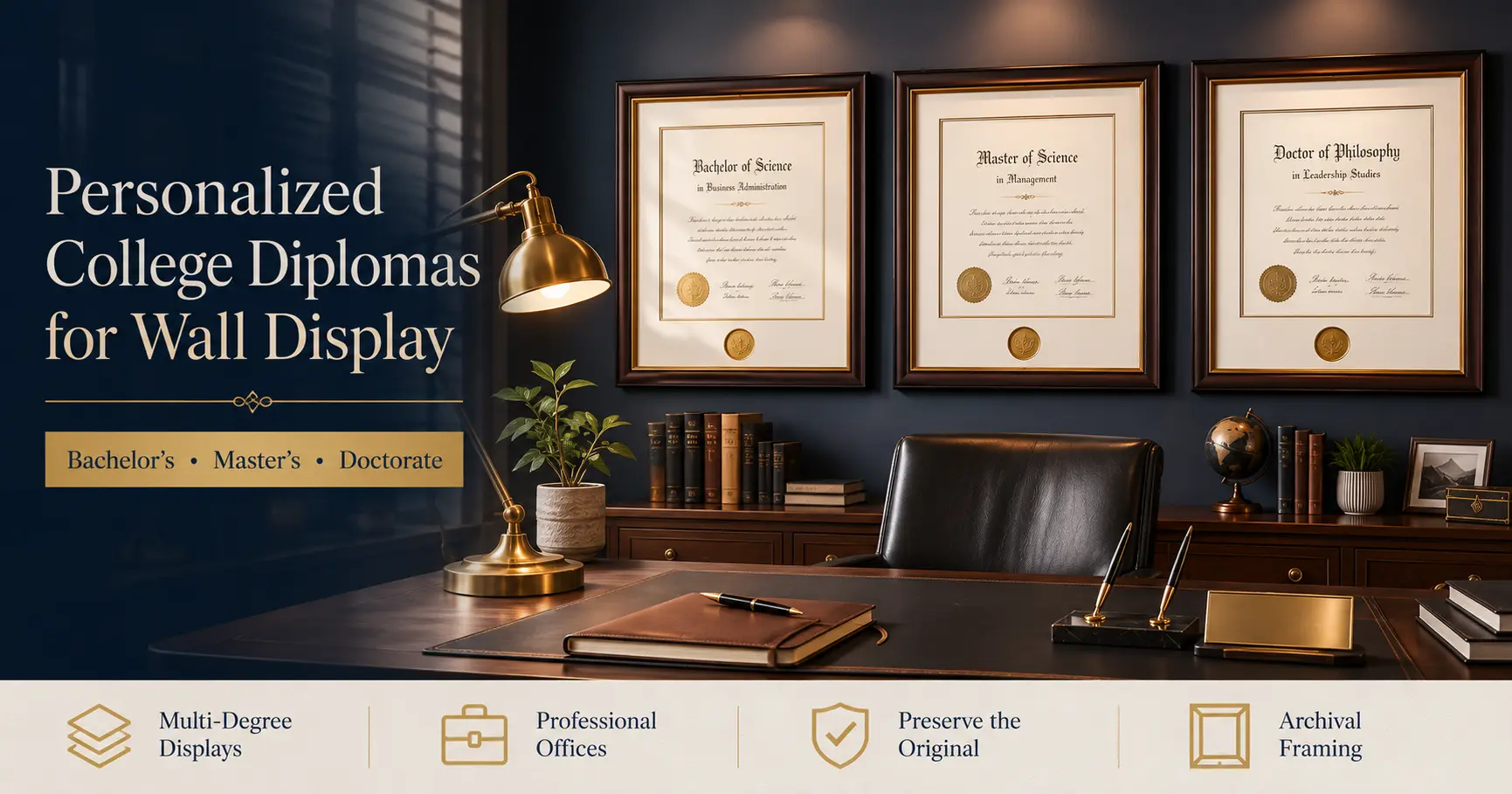
Last updated: 2026 · Design and display considerations for college, graduate, and professional degrees
College diplomas are heavier decisions than high school ones. The document itself is usually larger, more ornate, and more prominently displayed. The graduate spent more time, more money, and often more emotional effort earning it. And most graduates end up displaying their college diploma somewhere they'll see it for the next 30–50 years.
All of which means the decisions around framing, displaying, and — for many families — creating commemorative replicas for wall display matter more than they do for high school diplomas.
This guide covers the specific considerations for college diploma display: how personalized keepsake replicas work for college credentials, when they make sense (which is more often than most people realize), and how families approach multi-degree displays, professional school credentials, and long-term wall arrangements.
Table of Contents
ToggleThe Short Answer
A personalized college diploma replica is a hand-crafted commemorative reproduction of a college, graduate, or professional degree — customized with the graduate's name, degree, school, and graduation date — designed exclusively for display and keepsake purposes.
College graduates commonly order them when:
- They want to display the diploma but keep the original safely archived
- They have multiple degrees to display and want visual consistency across all frames
- They're building a home office, professional workspace, or family wall display
- The original diploma has been lost, damaged, or destroyed and official replacement is delayed or unavailable
- They want copies for multiple locations (home, office, parents' home)
Reputable providers clearly label these as commemorative replicas — they exist alongside the official diploma, never as a substitute.
Why College Diplomas Warrant Different Display Considerations
Three things make college diplomas different from high school diplomas in terms of display:
Size and formality. College diplomas are typically 11x14 or larger — some professional school diplomas run 14x17 or bigger. They're printed on heavier stock, use more formal typography, and often include significant Latin text and institutional seals. Framing them properly is a bigger commitment than framing a smaller high school diploma.
Multiple credentials. Many people accumulate more than one college credential over their lifetime — bachelor's degrees, master's degrees, doctorates, professional certifications. Display strategy has to consider not just this diploma but the ones that will come later.
Career-long relevance. High school diplomas are rarely displayed in professional workspaces. College diplomas often are — medical offices, legal offices, academic offices, consulting firms. That makes display quality and consistency more consequential.
The Case for Displaying a Replica
Most college graduates who visit our workshop start the conversation with a version of the same question: "Is it weird to want to display a replica instead of the original?"
The short answer: no, and it's actually what preservation-conscious graduates and academic institutions do routinely.
Consider the practical situation. A college diploma is typically issued on high-quality parchment or heavy cotton stock designed to last generations if properly preserved — but only if properly preserved. Displayed on a wall in a typical home or office environment for 30 years, that same diploma will show visible yellowing, potentially foxing (brown spots), and cumulative UV damage. Displayed in a preservation-grade museum frame with UV-filtering glass and acid-free matting, the damage is slowed but not eliminated. Stored in a climate-controlled archive with a preservation-grade replica displayed instead, the original stays essentially pristine indefinitely.
This is the same reason universities that possess famously historic diplomas — signed by prominent past faculty, for example — display facsimiles publicly while the originals stay in climate-controlled archives.
For personal college diplomas, families increasingly apply the same logic. The original goes in a fireproof, waterproof safe. A hand-crafted commemorative replica gets displayed. When the replica eventually shows age (10–20 years typically), it can be replaced without any impact on the original.
For the fundamental distinction between an official replacement diploma, a commemorative replica, and a fake diploma, see our replacement vs replica diploma explainer.
What Gets Personalized in a College Diploma Replica
College diploma replicas involve more customization than high school ones because college diplomas have more variable elements. A typical order specifies:
Graduate's full legal name at graduation
Colleges are strict about the name printed on the original diploma matching the graduate's official records at the time of graduation. Replicas typically follow the same convention — full legal name including middle name, exactly as it appeared on the original diploma. If the graduate wants a different version of the name displayed (a nickname, an anglicized version of an original-language name), that becomes a family decision, but historical accuracy is the more common choice.
Degree name and specification
The specific degree matters here more than at the high school level. "Bachelor of Arts" is different from "Bachelor of Science." "Master of Business Administration" is different from "Master of Business Administration in Finance." "Doctor of Philosophy in Molecular Biology" is different from "Doctor of Philosophy" without a field specification.
Check the original diploma if available for the exact degree wording. If the original is unavailable, the college registrar or transcript can typically confirm.
Institution name and location
The full official name of the institution — "The University of North Carolina at Chapel Hill," not just "UNC." Location is usually included ("Chapel Hill, North Carolina"). If the institution has been renamed since graduation, the replica typically uses the name as it existed at graduation, preserving historical accuracy.
Graduation date
Month, day, and year of the actual conferral ceremony. For graduates whose degree was conferred in absentia or without a formal ceremony, the date of degree conferral (as listed on the official transcript) is the standard.
Design elements
Institutional seals, ornamental borders, calligraphy style, Latin text — all these should approximate the era of the original diploma. A 1965 diploma design is visibly different from a 2020 diploma design. Reputable providers can approximate different eras when the original is available for reference.
Signatures
Original diplomas include signatures from the university president, board chair, department chair, and sometimes the dean. Replicas can include period-appropriate signature representations without impersonating specific individuals, or leave signature areas blank. Never should a replica include an actual reproduction of a specific real person's signature meant to look like it was signed by that person — that crosses into forgery territory.
Multi-Degree Display Strategies
Many college graduates accumulate multiple degrees over a career — bachelor's, master's, sometimes doctorate. Some add professional certifications, industry credentials, or law licenses. Displaying these together as a coherent visual story requires more planning than displaying a single degree.
Consistent framing across all degrees
Use the same frame style, wood, and mat color for every displayed credential. Mismatched framing across a career-long credential display makes the whole display look accidental rather than intentional. If you're displaying an original bachelor's diploma with an original master's diploma, use matching frames. If you're displaying replicas of both, use matching replicas from the same provider.
Chronological versus hierarchical arrangement
Two common approaches:
Chronological. Earliest credential on the upper left, most recent on the lower right (mirroring how English is read). Works well for graduates whose credential sequence tells a story (community college → bachelor's → master's, for example).
Hierarchical. Highest credential displayed most prominently, with lower credentials arranged supportively around it. Works well for graduates whose highest credential is the one most relevant to their current work (a doctorate for an academic, a JD for an attorney).
Combining credentials with related displays
College credentials often display well alongside professional certifications, board licenses, and specialty credentials. A physician might display their MD alongside their board certifications and state medical license. An attorney might display their JD alongside their bar admission certificates. A CPA might display their bachelor's degree alongside their CPA license. Framing these together, in consistent style, creates a comprehensive professional display.
Family wall arrangements
Some families display multiple family members' college diplomas on a single wall — parents, adult children, grandparents. Multi-generational college wall displays are meaningful, and they require the same consistency principles: matching frame styles, consistent mat colors, aligned heights. When some family members' original diplomas exist and others don't, hand-crafted replicas fill the gaps without disrupting the visual coherence. See our memorial diploma keepsakes guide for family memorial displays.
Professional School Considerations
Professional school diplomas — MD, JD, MBA, DDS, DVM, PharmD, DPT, etc. — often carry additional display considerations.
Office display versus home display. Many professional-school graduates display their diplomas in professional offices where patients or clients see them daily. This is standard practice in medicine, law, dentistry, veterinary medicine, and several other fields. Office display frames should be professional-grade both aesthetically and preservation-wise — patients and clients look closely at these credentials.
Board certifications and licenses. Professional school graduates typically add board certifications, state licenses, and specialty credentials over their career. These are usually displayed alongside the original degree. Frame consistency across all displayed credentials matters more in professional settings than in home displays.
Multiple office locations. Professionals with multiple practice locations sometimes want displays at each location. Original diplomas can be in only one place; commemorative replicas allow consistent, professional displays across all workspaces.
Retirement transitions. Retiring professionals often want their credential displays to move from office to home — but the original may have been displayed for 30+ years in the office and shows age. A fresh replica at the home office transition, with the original safely archived, is a common request.
Practical Ordering Considerations
Verify all details before ordering. College diploma customization involves more specific details than high school — exact degree name, exact institutional name, graduation date, sometimes specific honors (cum laude, magna cum laude, summa cum laude) or department affiliation. Confirm every detail against the original diploma or official transcript before ordering.
Provide reference images if the original is available. Reputable providers can approximate the design style of a specific era or institution more accurately if you provide a photograph or scan of the original diploma. For institutions with distinctive design traditions, this significantly improves the replica's authenticity.
Before choosing a frame, use our custom degree design tool to personalize the name, degree title, field of study, date, and layout, then preview how the finished keepsake will look.
Consider ordering with framing included. College diplomas benefit from archival framing more than most other document displays. See our guide to displaying your diploma at home for framing considerations, or order the replica pre-framed to avoid framing shop pricing.
Order in advance of the display need. Custom college diploma replicas typically take 2–4 weeks from order to arrival. If the display is for a specific date — a new office opening, a professional milestone, a family gathering — order 6–8 weeks in advance to allow for design revisions and shipping.
Browse our diploma keepsake display options for design styles appropriate for different college degrees and eras.
What a College Diploma Replica Is Not
The compliance line for college diplomas is the same as for any other keepsake replica, but worth restating because the stakes at the college level are higher:
- A commemorative replica is a decorative display piece, clearly labeled as a keepsake
- It is not an official diploma and cannot be used for employment verification, further education, licensing boards, or any verification purpose
- For employment or professional verification, employers use services like the National Student Clearinghouse to verify degrees through university records databases, not through the physical diploma document
- For any legal or professional purpose, the graduate uses the official diploma issued by the university, an official transcript, or a written verification from the university registrar
Reputable providers clearly label commemorative replicas as such, in the product itself and in order confirmations. If a "diploma replica" seller is marketing use for jobs, professional licensing, or verification — or refusing to clearly label the replica as a commemorative piece — they've crossed into fake-diploma territory. See our replacement vs replica explainer for the difference.
If you've lost your original college diploma and need an official replacement, contact the issuing university's registrar directly. The process is similar to (though usually slower than) the process for high school diplomas — for the general framework, see our lost diploma guide.
FAQ
Is it legal to buy a replica of my own college diploma?
Yes. Commemorative replicas of your own credentials, clearly labeled as keepsake pieces and used only for display, are legal decorative products similar to art prints or reproduced documents. What's regulated is use — using any reproduction to misrepresent your education is illegal regardless of who made it.
Will a replica look identical to my original diploma?
Very close but not identical. Reputable replicas approximate the original design carefully — same size, similar typography, similar layout, similar institutional elements — but they're not exact facsimiles of specific institutions' current documents, which would push toward forgery. If you provide a photograph of the original, the replica can be closer to matching the specific era and style.
Can I display a replica in my professional office?
Yes, for the same reasons offices display any framed credentials — recognition of achievement and professional presentation. Patients or clients rarely inspect diplomas closely, and reputable replicas are visually appropriate for professional display. If asked specifically whether it's the original, be honest.
Should I display my original college diploma or a replica?
For long-term preservation, displaying a replica and archiving the original is what preservation-conscious families and institutions typically do. Original diplomas are more honored by being preserved indefinitely than by slowly degrading on a wall. If you feel strongly about displaying the original, use museum-grade archival framing and choose a wall away from direct sunlight.
Can I order replicas of multiple degrees together?
Yes, and this is one of the most common orders. Graduates with bachelor's, master's, and doctorate degrees often order all three as a matched set for a coordinated display. Multi-degree orders typically receive volume pricing and produce a more visually coherent display than mismatched individual replicas.
What if my college has changed its name since I graduated?
The replica uses the institution name as it existed at graduation. This preserves historical accuracy — the achievement was earned at that institution, under that name, and that's what the replica commemorates.
What if my original diploma has been lost?
For the official replacement, contact your university's registrar's office. Most universities can issue replacement diplomas though the process may take 6–16 weeks and involve fees ranging from $50–$200. If you want something to display sooner or in addition, a commemorative replica typically arrives in 2–4 weeks and can be displayed permanently.
Can I get a replica for a degree conferred by a foreign university?
Yes. Replicas work for degrees conferred by any accredited institution worldwide. The customization process may involve additional details about the institution's design conventions, seals, and typography, so plan for slightly longer design proofing.
Should the replica include honors (cum laude, magna cum laude, summa cum laude)?
If your original included honors designations, the replica should preserve them for accuracy. If the original didn't include them, don't add them — honors are institutional designations that require verification against your actual academic record.
Can I order a replica of a degree I earned decades ago?
Yes. Many families order replicas of decades-old degrees — parents' graduate degrees, grandparents' professional certifications, deceased family members' credentials. The replica preserves the historical achievement in a form the family can display now.
What if the university where I graduated has closed?
Closed universities create the same records-recovery challenges as closed high schools. For official replacements, records are typically held by a successor institution or the state's higher education agency. See our closed school records guide. A commemorative replica can commemorate the credential from a closed institution regardless of whether official replacement is available.
Is a college diploma replica appropriate as a graduation gift?
Very much so. See our ultimate graduation gift guide for context on graduation gifting. Custom-crafted commemorative replicas are among the most kept and displayed graduation gifts — often on walls decades after the graduation itself.
This guide reflects display and preservation practices used by families, universities, and archives. Every institution's original diploma has distinctive design elements — for authentic replicas, providing a photograph or scan of the original significantly improves the outcome.