
Last updated: 2026 · Based on archival preservation guidance and framing industry standards
You worked for that diploma. Whether it's yours, your child's, your spouse's, or a grandparent's, it deserves to be seen — not left in a cardboard tube in the back of a closet slowly yellowing from age.
But displaying a diploma properly is trickier than most people realize. The wrong frame, the wrong wall, or the wrong lighting can permanently damage a document that's supposed to last generations. And most of the "diploma display" advice on the internet is either sponsored by frame companies or copied from decor blogs by people who've never actually thought about paper preservation.
This guide covers what actually works: how to protect the original, how to make the display look good, where to put it, and — importantly — when to display a replica instead of the original. That last decision is one archivists routinely recommend but most homeowners never consider.
Table of Contents
ToggleThe Short Answer
If you want your diploma to look good and last:
- Never display the original in direct sunlight. UV destroys paper faster than anything else.
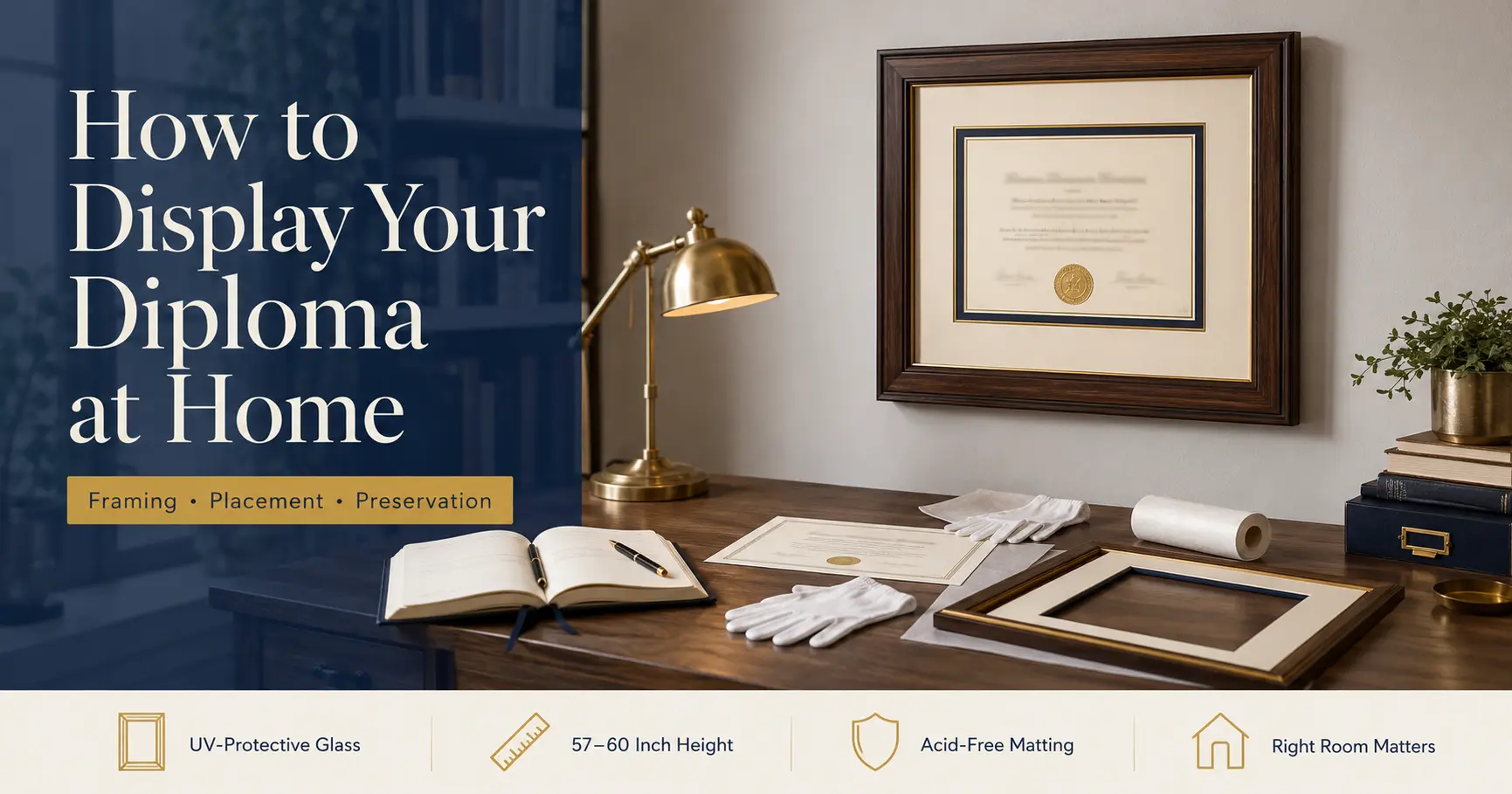
- Use a UV-protective frame with acid-free matting. Standard picture frames aren't good enough.
- Consider displaying a keepsake replica and archiving the original. This is what museums do with their most valuable documents.
- Match the frame to the room, not just the diploma. A traditional diploma in a modern minimalist frame looks intentional. Random frame-to-diploma pairings look cheap.
- Hang it at eye level in a room you actually spend time in. A diploma in the guest bathroom might as well be in a closet.
For the full walk-through, keep reading.
Why Displaying the Original Isn't Always the Best Idea
Here's something most people don't know: the original diploma is usually the wrong document to hang on the wall.
Diplomas are printed on parchment, heavyweight cotton stock, or coated paper — materials that respond badly to the conditions of a typical home. Consider what a framed diploma actually endures:
- UV exposure. Even indirect sunlight breaks down cellulose fibers, bleaches inks, and yellows paper. According to the Library of Congress preservation guidance, ultraviolet radiation from natural and fluorescent light causes cumulative, irreversible damage to paper documents.
- Humidity fluctuations. Paper expands and contracts with humidity. Repeated cycling causes warping, foxing (brown spots), and mildew.
- Temperature swings. Rooms with big temperature changes — near windows, above radiators, in unheated hallways — accelerate all forms of paper degradation.
- Acid migration. Contact with acidic materials (most cardboard backing, non-archival mats, wooden frame components) transfers acid to the paper over years, causing embrittlement and discoloration.
- Physical accidents. A diploma on the wall for 40 years has 40 years of opportunities for the frame to fall, the glass to break, water to leak from an upstairs bathroom, or a moving day to end badly.
The archivist's solution to this — the same approach used by museums, universities, and government archives — is to display a high-quality reproduction and store the original. This isn't about deception. It's about preservation. Every time you see a "famous document on display" at a museum, you're often looking at a facsimile; the original is climate-controlled in the vault.
For a personal diploma, the same principle applies. Store the original in a fireproof, waterproof safe. Display a keepsake replica on the wall. When the replica eventually fades or gets damaged, replace it. The original stays pristine.
This isn't the only valid approach. Some families feel strongly about displaying the actual original. If that's you, the framing and placement guidance below still applies — you'll just want to be extra rigorous about UV protection, humidity control, and archival materials.
Choosing the Right Frame
Not all frames are equal. If you've been to a big-box store and grabbed a generic "diploma frame," you probably don't have what you need.
The three levels of framing quality
Level 1: Standard picture frame ($15–$40). Basic acrylic or glass front, no UV protection, non-archival backing. Fine for kids' art projects and posters. Not appropriate for anything you want to keep long-term.
Level 2: Diploma-specific frame ($40–$150). Usually includes school-color matting, embossed school seal, and diploma-sized cutouts. Some include UV-resistant glass. Aesthetically appropriate but preservation quality varies widely. Check specifically for "conservation grade" or "UV-protective" labeling.
Level 3: Museum-quality archival frame ($150–$400+). Museum-grade UV-filtering glass (blocks 97%+ UV), 100% acid-free matting and backing, corner spacers to prevent glass contact with paper, sealed backing to control humidity. This is what universities use for their own displayed documents.
If you're displaying the original diploma and expect it to last more than 20 years on the wall, Level 3 is worth the money. If you're displaying a keepsake replica (which you can replace if it fades), Level 2 is usually sufficient.
What to look for specifically
- UV-filtering glazing. Museum-grade UV glass or acrylic (Optium, Tru Vue Conservation Clear, or equivalent). Blocks 97–99% of UV without noticeable tint.
- Acid-free, lignin-free matting. The mat around your diploma should be 100% cotton rag or acid-free wood pulp. Cheap mats will yellow within 5 years and can transfer acid to your diploma.
- Sealed backing. Foamboard or acid-free corrugated board with a sealed dust cover on the back. Prevents dust, insects, and humidity fluctuations.
- Spacers between glass and paper. The diploma should never touch the glass directly. Contact causes moisture buildup and can permanently adhere paper to glass.
- Hanging hardware appropriate for weight. Larger archival frames can weigh 5–10 pounds. Use appropriate wall anchors, not the flimsy sawtooth hangers that come pre-installed on cheap frames.
Frame style: matching the room, not just the diploma
This is where most people get it wrong. They pick a frame that "matches the diploma" (heavy dark wood with gold accents, embossed seal) and hang it in a room where nothing else looks like that. Result: the frame looks like it wandered in from a lawyer's office.
Better approach: pick a frame style that fits the room you're displaying in.
- Traditional room (dark wood furniture, warm colors): classic mahogany or cherry frame, wide mat, embossed seal is fine
- Modern room (clean lines, neutral colors): minimalist black or natural wood frame, wide plain mat, no embossing
- Farmhouse/rustic room: distressed wood or reclaimed-look frame, off-white or cream mat
- Home office / study: heavier traditional frames read as intentional and professional
- Bedroom or hallway: simpler, quieter frames blend better
Where to Hang It
The room matters as much as the frame. Some rooms are actively hostile to paper documents.
Best rooms for diploma display
Home office or study. Consistent temperature and humidity, minimal sunlight if the desk is positioned properly, an appropriate context. This is the classic diploma location for good reason.
Living room or family room. Works if the room doesn't get direct sunlight for extended periods. Consider the "gallery wall" approach — grouping diplomas with family photos and other framed items.
Hallway or staircase. Usually stable environmentally, and hallways are great for multi-generational family diploma displays.
Dining room. Traditional and formal-feeling. Watch for humidity from cooking and heat from candlelight.
Rooms to avoid
Bathrooms. Humidity destroys paper. Even a diploma in a "well-sealed" archival frame will eventually degrade in a bathroom environment.
Kitchens. Grease, humidity, heat, and cooking odors all settle into paper and fabric mats. A diploma above the stove will be visibly yellowed within 5 years.
Basements. Humidity, potential for flooding, temperature instability. Even finished basements are usually worse for paper than the main living areas.
Attics. Extreme temperature swings and humidity. Never store or display in an attic.
Near heating vents, fireplaces, or radiators. The hot dry air adjacent to these fixtures causes rapid paper embrittlement.
Any wall that gets more than 2 hours of direct sunlight daily. Even with UV glass, cumulative sun exposure causes damage.
Height and placement
Hang the center of the frame at 57–60 inches from the floor — this is standard gallery hanging height and corresponds to average adult eye level. Higher than 60 inches makes the diploma feel disconnected from the room; lower than 57 makes it feel like it slipped down the wall.
For multi-diploma displays, treat the group as a single visual unit and center the group at 57–60 inches. Individual pieces within the group can vary in height as long as the overall composition feels balanced.
Multi-Diploma and Family Wall Displays
One diploma looks like an office decoration. A wall of diplomas looks like a legacy. If your family has multiple graduates — or you have multiple credentials of your own — grouping displays create a much stronger visual and emotional impact.
Multi-credential display for one person
High school diploma, college diploma, graduate degrees, professional certifications. Grouped together, they tell a career story that a single frame can't. Consider matching frame styles across all pieces — same wood, same finish, same mat color — to create visual coherence.
Chronological arrangement usually works best: earliest credential upper left, most recent lower right (mirroring how we read).
Multi-generational family wall
Grandparents, parents, adult children. This is one of the most meaningful diploma displays a family can create — and one of the most common reasons families order keepsake replicas. Older generations' original diplomas often no longer exist, or they exist but are too fragile to display. Keepsake replicas fill those gaps, letting the family wall span every generation without empty spots.
If you're doing this: pick a consistent frame style, use matching mat colors, and consider small brass or engraved plates identifying the graduate and graduation year below each frame. This turns a diploma display into a genealogical statement.
Practical composition tips
- Lay everything out on the floor first, adjusting until the composition feels right before you put a single nail in the wall
- Photograph the floor layout, then use it as reference when hanging
- Use kraft paper templates cut to frame size to test wall placement before hammering
- Leave 2–4 inches between frames — closer and they feel crowded, farther and they read as separate pieces
- Anchor the display to something (a piece of furniture, a doorway) rather than floating it randomly on the wall
Combining Diplomas With Other Display Items
A diploma doesn't have to hang alone. Some of the most powerful displays combine the diploma with related items that tell a fuller story.
Shadow box displays pair the diploma with related keepsakes — the graduation cap tassel, the honor cord, a graduation ceremony program, a photograph of the graduate in cap and gown. These work especially well for milestone graduations (first-generation college graduates, military-education combinations, professional-degree completions).
Photo groupings pair the diploma frame with graduation ceremony photos, family photos from graduation day, or portrait photos of the graduate. Consider using the same mat color across the group to unify the composition.
Memorial displays combine a keepsake diploma replica with photographs, small memorial objects, and personal items when honoring a deceased family member. Our memorial diploma keepsakes guide covers this specific scenario in depth.
Career achievement walls combine the diploma with professional certifications, industry awards, published papers or patents. Common in home offices for professionals whose credentials matter to their identity.
Long-Term Care and Maintenance
Once your diploma is on the wall, it's not maintenance-free. A few habits will extend its life significantly:
- Rotate seasonal light exposure. If any wall gets more sun in summer than winter, consider moving the diploma to a different wall during high-sun months.
- Dust the frame monthly. Use a soft microfiber cloth. Don't spray cleaning products directly on the frame — the liquid can seep behind the glass.
- Check for condensation. If you ever see moisture inside the glass, remove the diploma from the frame immediately, let it air-dry flat between acid-free tissue, and get a new archival frame. Trapped moisture causes irreversible damage within days.
- Inspect annually. Once a year, take the frame down and look at the back for signs of insect activity, adhesive failure, or backing degradation.
- Update your scan every 5 years. Even a well-displayed diploma will eventually fade or yellow. Rescan every 5 years so you always have a current-condition digital backup.
Common Display Mistakes to Avoid
The most common mistakes we see, in rough order of how much damage they cause:
- Cheap frame with no UV protection in a sunny room. This is the fastest way to destroy a diploma. Yellowing and ink fading start within months.
- Non-archival mat directly touching the diploma. The mat acid transfers to the paper. Brown edges appear within 3–5 years and are permanent.
- Glass touching the paper. Without spacers, moisture buildup adheres the paper to the glass. Removal without damaging the diploma becomes impossible.
- Displaying in a bathroom, kitchen, or basement. Environmental conditions accelerate every form of paper degradation.
- Hanging with a single nail through the frame's sawtooth hanger. Frames larger than 11x14 need two-point hanging (two nails or a wire) to stay level and not fall off the wall.
- Grouping mismatched frame styles. Not damaging, just aesthetically weak. Consistency is what makes multi-diploma walls look intentional rather than accidental.
When to Choose a Replica for Display
Coming back to the archivist's approach: displaying a replica and archiving the original is the safest long-term option for most families. It's worth considering explicitly if any of these apply:
- The diploma is 30+ years old and starting to show age. Further display exposure accelerates aging that's already happening.
- You want to display in a room with sunlight, humidity, or temperature swings you can't control. A replica in a compromised location is much lower risk than the original.
- You're building a multi-generational family wall. Older family members' originals often don't exist. Consistent-quality replicas across all generations look better than mismatched originals and empty spots.
- The diploma has irreplaceable sentimental or historical value. First-generation graduate, deceased family member, immigrant relative — display the copy, preserve the original.
- You want multiple displays. One diploma, but you want copies in the main home, the vacation house, and the parents' place. Only replicas allow this.
Reputable keepsake providers hand-craft replicas designed for exactly this purpose. Browse our diploma keepsake display options to see designs approximating common diploma styles from different eras. For the distinction between replicas and official replacements, see our replacement vs replica diploma explainer.
FAQ
Should I display the original diploma or a copy?
For long-term preservation, archivists recommend displaying a high-quality copy and storing the original in a climate-controlled environment. This is the same approach museums use for valuable documents. If sentimental attachment to the physical original matters, use museum-grade archival framing and choose a wall away from direct sunlight.
What's the difference between a diploma frame and a picture frame?
Diploma frames are usually sized to standard diploma dimensions (typically 8.5x11 or larger with matting to 11x14), include school-color matting or embossed school seals, and may include UV-resistant glazing. Standard picture frames are usually smaller, don't have preservation features, and aren't designed for long-term document display.
How much should I spend on a diploma frame?
For displaying an original diploma long-term, spend $150–$400 on a museum-grade archival frame. For displaying a keepsake replica (which can be replaced if it fades), a $40–$150 diploma-specific frame with UV-resistant glass is usually sufficient.
Can I use a regular picture frame if I add UV film to the glass?
Aftermarket UV film adds partial protection but doesn't match museum-grade UV glass. If long-term preservation matters, use a purpose-built archival frame from the start.
Where should I hang my diploma?
Home office, study, living room away from direct sunlight, or hallway. Avoid bathrooms, kitchens, basements, attics, and any wall with more than 2 hours of daily direct sun.
How high should I hang a diploma?
Center of the frame at 57–60 inches from the floor. This is standard gallery hanging height and corresponds to adult eye level.
Can I hang multiple diplomas together?
Yes, and it usually looks better than displaying them separately. Use matching frame styles for visual coherence, leave 2–4 inches between frames, and consider chronological or family-tree arrangements.
My diploma is starting to yellow. Can I restore it?
Professional paper conservators can slow or partially reverse yellowing, but the process is expensive ($200–$800) and doesn't restore documents to original condition. Prevention through proper framing is much more effective than restoration.
Is it disrespectful to display a replica instead of the original?
No. Displaying a preserved copy is standard archival practice for valuable documents. The original is more honored by being properly preserved than by slowly degrading on a wall.
Can I frame my diploma myself?
Basic framing yes, but archival-grade framing is technical work. If the diploma matters to you, spend the $100–$200 to have a professional custom framer do it — the materials alone often cost as much as a professional job.
What if my diploma is water-damaged?
Don't display it as-is. Consult a paper conservator about restoration options, and in the meantime request an official replacement from your school district. See our lost high school diploma guide for the replacement process.
How long will a properly framed diploma last?
Museum-grade framing in appropriate environmental conditions can preserve paper documents for 100+ years without significant visible degradation. Standard diploma frames in typical home conditions will show visible aging in 20–40 years.
This guide draws on preservation guidance from the Library of Congress and the American Institute for Conservation of Historic and Artistic Works. Home environmental conditions vary significantly — when in doubt about a specific display situation, consult a professional custom framer or paper conservator.